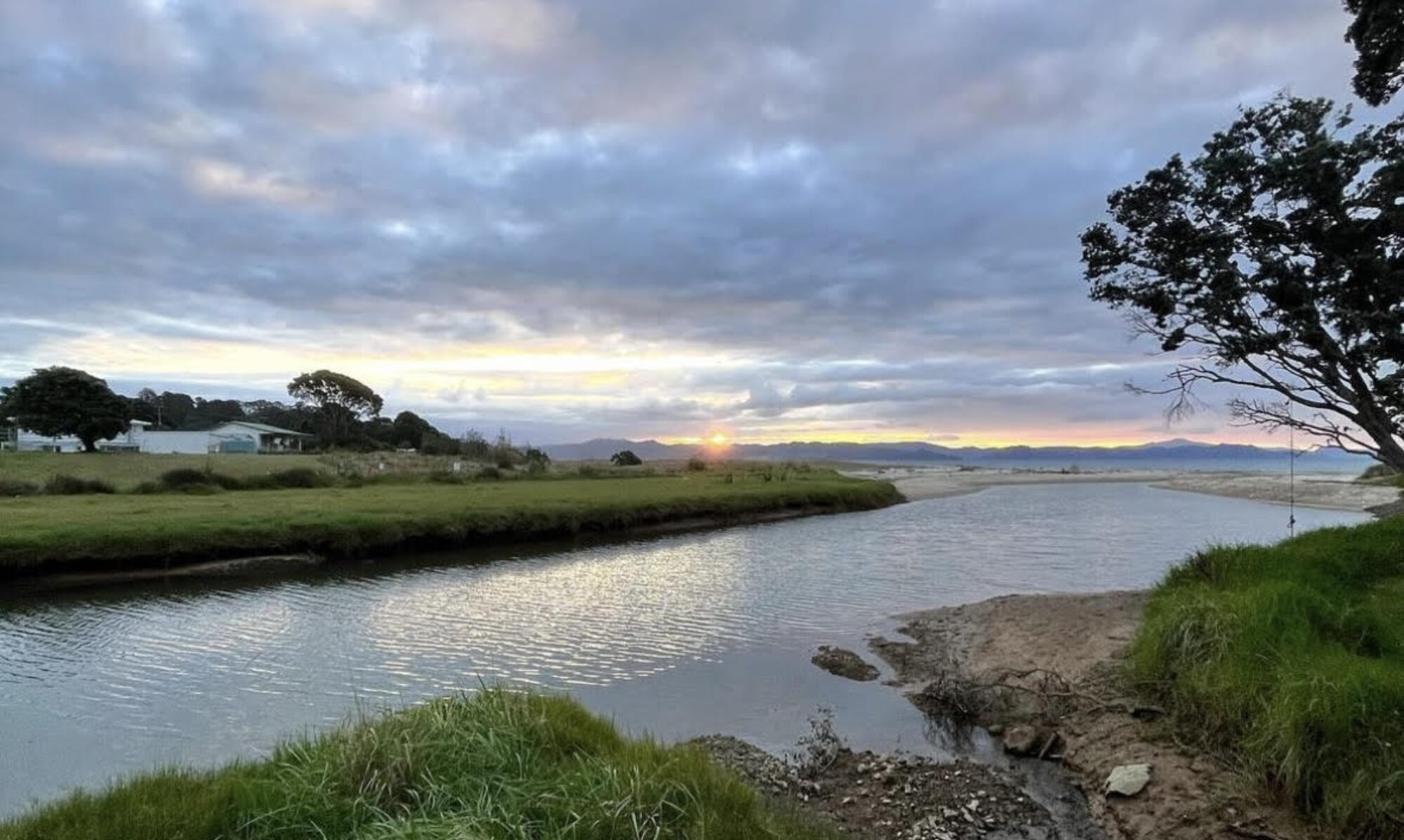
Sunrise selfie taken from the passenger seat of my friend Suzi’s car as she drove us to AKL airport, 7:20 am, May 16, 2026.
There’s much to say on the topic of when a place becomes your home. Is it the people? Is it how deeply you connect with the culture? Is it when you have a bank account, a car, a job? Is it measured in milestones? Or the accumulation of memories?
Because I’m down to my last few minutes on the Cape, with half a cup of coffee to go and this laptop as the very last thing to be packed, I’ll leave that question for a future post.
Ever since I was granted my NZ resident visa in August 2025, people ask me whether or not New Zealand feels like home now. And my answer is always the same: yes, but so do the States. I have a foot very firmly planted in two very different (and distant) countries. I have two homes.
When talking to loved ones on either side of the pond, I am always hyper-aware of which country I am referring to as my “home.” I know it might sting for a close friend in NZ to hear me still referring to the States as “home,” but likewise I know it lands heavily for a family member or old friend in the States to hear me call New Zealand “home.” I not-infrequently catch myself saying something along the lines of “I can’t believe I fly home in three weeks! Well, not home-home. Other home.” And then, for clarity, I’ll add one last “Home” with air quotes, just to make sure you get it. Because I need you to understand that I understand how hard this is for you. And for me.
For the past two years, I have been lucky enough to live and work for about 1/3 of the year in the United States and the rest of the year in New Zealand. I’m able to pull this off thanks to my NZ resident visa, seasonal jobs in both countries (with incredibly understanding bosses who are okay with me leaving for a long time), family and friends who are understanding of my free spirit, and a loving and truly supportive partner who genuinely gets how important this is to me–and who not only understands but agrees that a little time apart can be good for a relationship.
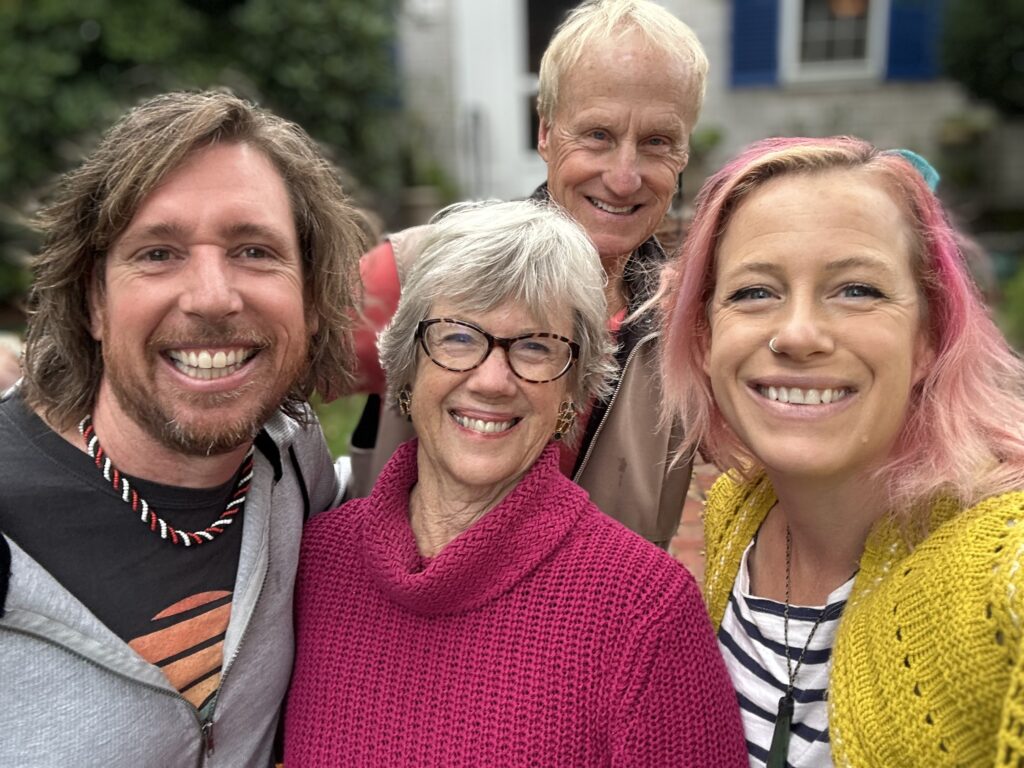
As I have once again packed the contents of my life into a 21.78 lb carry-on suitcase and a 49.99996 lb checked bag and prepare to move from one country to the other one, I am struck by not only how excited I am to see NZ again, but how homesick I am for Cape Cod, even though I’m still here. It’s getting down to the “last” of everything: the last time I need to put gas in my tank, the last library book I need to return, the last few gifts I need to buy, the last time I’ll see [insert your name here] for a while. The last time I can call my sister on a whim without doing the math in my head about what time it is there. The last time I’ll be hanging with my parents for a while. And likewise, next year I’ll be running through the same cycle in reverse: the last time I need to put petrol in my tank, the last few gifts I need to buy, the last time I’ll be the one with the funny accent, the last time I’ll be able to give Stu a little peck on the cheek. Twice a year, I find myself homesick for the home I’m still in, while simultaneously excited to return to the other one. It’s a whole thick, complicated, tiring mess of emotions. But oh, how lucky am I to be able to have this life!
Pretty soon I’ll be tapping my heels together three times and repeating, “There’s no place like home, there’s no place like home.” And the strange and beautiful part: I’ll mean it in both directions.
The internet likes to aggressively market travel-related products to me. The latest is an ad for this “global tote bag,” which seems to elicit perfectly white smiles from perfectly white women enjoying $18 al fresco lattes.
I’m too fired up to try and de-pixellate this, but I’m sure you’re not seeing what I’m not seeing.
Despite having not purchased this shoddily-researched and cheaply made tote bag, I was allowed to leave my scathing, all caps, one star review. Which for some reason they didn’t post.
COWARDS.
Read more about New Zealand being left off world maps in my previous blog post.
Don’t worry; this is not a story filled with turbulence and mechanical failures. I wouldn’t do that to you. None of what I’m about to tell you happened in the sky.
There are two parts to this story: the 📞 part, and the 💣 part.
It was July 2022. New Zealand had finally, after more than two and a half years, reopened its borders to international travelers. I was flying back to see Stu. We were both beside ourselves with excitement. Gah, I can’t believe you’ll finally be back in New Zealand so soon!, he wrote, as I left for the airport. Ahhh, don’t jinx it!, I replied, adding a crying-with-laughter emoji followed by a heart.
I flew from Boston to San Francisco, arriving sometime in the morning. I grabbed my luggage and settled in for my 14-hour layover. Yes, you read that right: 14 hours. I know; that’s an absurdly long layover, but flying to NZ is expensive and for the right price I’ll literally hang off the wing of the plane. Also, airlines generally recommend arriving three hours before international flights, so I like to leave…a lot of extra time in case something goes wrong.
What do you mean, “in case something goes wrong?”.
Buckle. Up.
En route to finding the cozy, secluded spot that would be my home for the next 13.5 hours, I headed to the bathroom, where I–as always–took my phone out of my back right pocket and–as always–put it on top of the toilet paper dispenser. This was one of those absurdly small airport bathroom stalls where you’re struggling to get your bags in just so that you can shut the door, and it’s literally impossible to exit the stall without you and your luggage dramatically bursting out like you’ve just been shoved out of a clown car. I tumbled my way out of the stall, washed my hands, grabbed my bags, walked out and around the corner, headed towards the bookstore, realized I’d left my phone on top of the toilet paper dispenser, went back to the stall, and it was gone. It happened that fast. Less than two minutes. I never saw another person there, and (spoiler alert) I also never saw that phone again.
Your immediate reaction nowadays when something goes wrong is to reach for your phone. What do you do when you don’t have it? I suddenly felt like I was standing naked and vulnerable in the middle of San Francisco airport. I have to call my…I thought, and then went …oh. I have to text–oh. Wait, I can goog…..oh. Oh, no. For those first few minutes after your phone is stolen, you are completely and utterly helpless.
I happened to be standing next to an SFO “courtesy phone” attached to the wall, and, having no idea how they worked, tried calling my sister, who is both one of the most resourceful people I know and also the only person whose phone number I knew by heart (later I had to have my sister contact Stu, whom she had never even met, via Facebook messenger to let him know what had happened because I didn’t know his number except that it started with the country code +64).
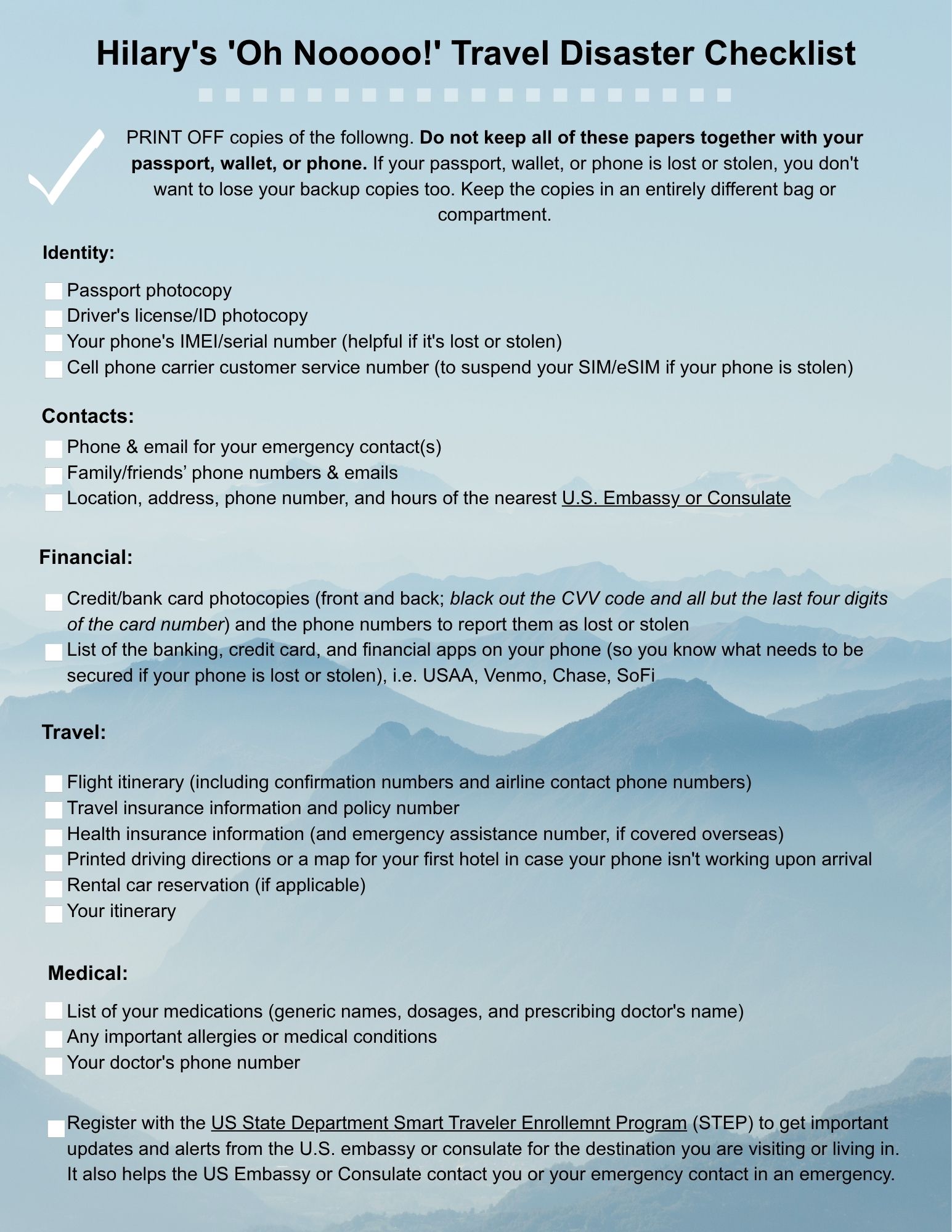
Which leads me to item #1 of my Oh S**T Travel Disaster Checklist:
Fiordland National Park, South Island NZ, 2020
Remarkably, the SFO courtesy phone was both functioning and free (my sister later told me that her reaction upon seeing “SAN FRANCISCO AIRPORT” come up on her caller ID was “Uh oh”). I stumbled over my words as fast as I could while she put me on speaker and tracked my phone on her phone. What followed was several minutes of her telling me where my phone was (on the move, in the general area I was standing), I’d hang up and bustle off with my bags in desperate hope that I would…I don’t know…see someone holding my phone, which looks like everyone else’s phone, and then like…roundhouse kick them in the face and forcibly take it back?
After each failed attempt at spotting my phone, I’d run back to the courtesy phone to call my sister for location updates. After a few minutes my phone was shut off, the signal dropped, and it was gone for good.
I grabbed a pen and paper from my bag (note: never find yourself without a pen and paper) while my sister did some speedy googling and told me 1. the location of the SFO airport police desk, 2. the location of the taxi stand at SFO, because of course I couldn’t use Uber because I didn’t have a phone, and 3. the location of the nearest T-Mobile store.
I made my way to the SFO police headquarters where, with the unmistakable look of someone who knows this is a complete waste of everyone’s time, a policeman handed me the report to fill out. Which brings us to…
Oh S**T Travel Disaster Checklist item #2:
I handed the report back, myself now wearing the unmistakable look of someone who realized that was a complete waste of everyone’s time, and went out and hailed a taxi like it was ye olden days of 1987. I handed the driver the scrawled address of the store my sister had told me about, which was 25 minutes away. (See?! Thank god I had a 14-hour layover you guys!!). Although I have insurance to cover a stolen phone, it wasn’t something they could magically do on the spot, so they sold me the cheapest smart phone they had and informed me I could go through the stolen phone/insurance process when I was Stateside again in 3 weeks.
I can’t remember what kind of phone it was, but when I say I hated it, I mean I absolutely *loathed it*. Gone were the familiar swipes and taps and icons of my beloved iPhone, instead replaced by a weird lock screen with a stupid geometric picture on it, some obtuse way to get past the lock screen into the phone itself, and–of course–none of my apps and contacts. I took a taxi back to the airport, found a secluded corner where I could panic privately, and proceeded to try and remember all of my banking and social media apps, and then figure out how to download apps on this stupid phone, and then install each of them and log into each one of them, change the password, and make sure everything was in order, the whole time imagining a group of balaclava-wearing guys in a van rapidly siphoning money out of my bank accounts. Oh S**T Travel Disaster Checklist item #3:
So the trip was going great so far, and I still had another 8 hours before my flight boarded. I’m not advocating that people traveling abroad get to the airport 14 hours early, but I’m not not saying they should.
I made my way to the Fiji Airways desk in the International terminal, which was at the very end of what seemed like a comically long corridor ending with at a set of escalators. I went down into a cavernous space with floor-to-ceiling windows, lots and lots of chairs, zero people, and two generic, unaffiliated airline desks, both of which were deserted with blank screens above them. It turns out I was so early for my flight that the check-in counter didn’t exist yet. Did you know that sometimes generic airport counters sit there completely unaffiliated until an airline suddenly appears from the mist several hours before a flight, like Brigadoon? Neither did I.
I awoke from a nap to find that a few other people had joined me. And then a few more. By the time check-in was within an hour, the whole section was crowded with people. The desk remained unmanned, but when the board illuminated with our flight number and departure time, I was finally able to relax. I was going to New Zealand to see Stu! It was really happening! I settled back into my chair with a sigh of relief.
Oh but wait, there’s more. Remember when I used the “bomb” emoji earlier? Yeaaaah…..
En route to Milford Sound, 2020. That tiny dot in the center is the shadow of our Cessna.
Within the space of about thirty seconds, everyone who was looking down at their phones started muttering, which is a pretty terrifying thing to have happen. I asked the guy next to me what was happening. He informed me that the entire airport had been evacuated because there was a bomb threat and a suspicious package had been found in the International Terminal.
I’m sorry, WHAT?
I called up a news article online and yep, sure enough, not one hour ago the airport police had received a bomb threat after someone was found acting erratically alongside a suspicious package (we found out later that it was a young man having a mental health crisis and that the package was completely harmless). But the whole thing went down in that long, long corridor that separates the International terminal from the Domestic one: right between where we were sitting and the entire rest of the airport. They evacuated “everyone” except somehow forgot about the 200-something of us essentially trapped at the end of the building. No one ever came to check on us or tell us what was going on. Here’s proof I’m not making this up.
By this time it was 10 p.m. and our flight was scheduled to leave at 11 p.m., which was obviously not going to happen, and yet the information board above the desk was still confidently insisting we were leaving at 11 p.m. I was so delirious at this point that I was imagining myself being interviewed on national television about the whole ordeal, and I thought I was pretty clever for saying “You know, when you think of everything that could go wrong with a flight, this isn’t that bad.” The reporter laughed.
A little while later the board changed to say we were now departing at 12:30 a.m.. There was a collective muttering. Then it changed again to say 2 a.m., and there was a collective moan. By the time it changed to 3 a.m., most people were asleep.
But, remarkably, our plane did leave at 3 a.m., and when I got to the desk and realized I’d forgotten to download the Fiji Airways app that had all my flight information, I just pulled out the printed copy of my itinerary and boarding pass.
Oh S**T Travel Disaster Checklist item #4:
Because our flight left four hours later than expected, we all missed our connecting flights in Nadi. As we got off the plane there were cheerful people in bright floral shirts and big smiles, welcoming us to Fiji and directing us which line to join depending on where your connecting flight was supposed to go. I have to say, Fiji Airways was amaaazzing with the whole bomb scare thing, even though it had nothing to do with them. I joined the Auckland line, and by the time I got to the smiling woman with a frangipani flower tucked behind her ear, she informed me that I was on the flight to Auckland that left tomorrow afternoon, but not to worry because they were putting us up for the night in a gorgeous resort and giving us a food and drink allowance. As we waited for the shuttle to the resort, I managed to pause my nervous energy and marvel at how beautiful everything around me was. And the resort was gorgeous, and my room was great, and I was able to take a shower, and the free drink and free pizza were fabulous. But then, as I was chatting to my fellow stranded passengers, I found out that *they* were on a flight to Auckland in just a few hours, but unfortunately that flight was full.
I had to get on that flight. I *absolutely had* to get on that flight.
I booked it back to my hotel room and proceeded to try and call Fiji Airways to have my flight switched, but the goddamned smartphone they sold me back in San Fran, the one they promised me worked in other countries, did not in fact work in other countries. I’d finally get through to the airline and the call would suddenly disconnect, or it would give me the busy signal, which I’m pretty sure isn’t something you’re supposed to hear when you call a major airline.
Throughout this whole ordeal, I was frantically texting my sister, the lone contact in my phone. The keyboard was a nightmare, the predictive text was so far off the mark it felt like it had to have been an inside joke with the developers, and then at one point the phone started inserting shrimp emojis for absolutely no reason while also trying to get me to pay for something.
My texts went something like this:
Whitianga from above, 2025
“Thss is the moist insane tounge ever the resport is beautiful 🦐and but I cant enjo🦐🦐 what the F**K 🦐🦐🦐 🦐 🦐 ITS TYING TO make ME PAY for srimp emajs i dant anymore.” I also remember her writing back telling me she was so sorry but she could not stop laughing.
I finally gave up on trying to get through on my cell phone and used the hotel room phone, knowing it would cost a fortune. But I did eventually get on that earlier flight.
As I waited in the lobby of the resort for the airport shuttle, the soft, warm breeze and subtropical flora everywhere renewing my sense of bliss and excitement, I treated myself to a flat white—the delicious, creamy Oceania version of a latte—which I had the absolute pleasure of enjoying while chatting with a group of enormous Pacific Islander guys, all of them covered in traditional tattoos. They told me they were professional rugby players in New Zealand who had since been recruited to play in Japan, which is when I learned that rugby is apparently huge in Japan. I remember how kind they were, and how adorable it was that these absolutely massive men were, like me, sipping at their flat whites that looked Alice-in-Wonderland dwarfed in their mitts.
Alas, though, we are not quite to the end of this ordeal yet. When I went to check out of the hotel to catch the shuttle back to the airport, the man behind the desk informed me that my phone calls to my sister and Fiji Airways from the hotel phone had cost me $285 USD. Which, of course, I had no choice but to pay. But then I remembered that—aha!—I was smart enough to have purchased travel insurance for just such a scenario!
Oh S**T Travel Disaster Checklist item #5:
Let’s talk about travel insurance for a second. People ask me about it, assuming that I’m well-versed in the subject. I am not. The one time I ever purchased travel insurance was for this trip, and they covered exactly none of it—including the $285 hotel room phone bill.
Which I found appalling, because have you ever actually read the fine print of a travel insurance policy? It’s always so incredibly specific and absurd. You’d think this would be exactly the sort of ridiculous chain of events travel insurance was designed for: “If your plane gets delayed for more than two hours due to a false bomb threat, and you accrue upwards of $100 in hotel-room phone charges because the replacement phone you purchased after your original phone was stolen doesn’t work in Fiji even though the guy who sold it to you promised it would…”
But nope. They denied my claims. I did eventually get credit for the phone bill, though. My sister called T-Mobile, told them my entire saga, and threatened to burn down the person’s grandmother’s house if they didn’t credit me. Thanks, Gillian!
Here is a summary I made about how I personally feel about travel insurance. Click on the first photo so you can read them better. Note: I am *absolutely not* trying to talk anyone out of getting travel insurance. I cannot stress this enough. I just had a bad experience with it the one time I tried it. You should do your own research and make the decision based on that, rather than on one chaotic woman’s unhinged blog post.
After all of this, the stolen phone, the bomb threat, the shrimp phone, I did end up making it to Auckland, 12 hours later than planned, and I ran off the plane and straight into the arms of the most beautiful man I’d ever met.
Ngā mihi nui to my whānau and e hoa mā (thank you so much to my family and friends) who actually read this in its entirety.
Aroha always,
Hilary ❤️🦐🦐🦐
And now please cast your eyes upon “Hilary’s “Oh Noooo!” Travel Disaster Checklist.”
May you never need to use it but, if you do, may my suffering be your saving grace.
Click the checklist below to download the PDF and print your own copy.
As written by an American washashore and relative newcomer to the country who is in no way, shape, or form a historian (but who is a big fan of fact-checking!)
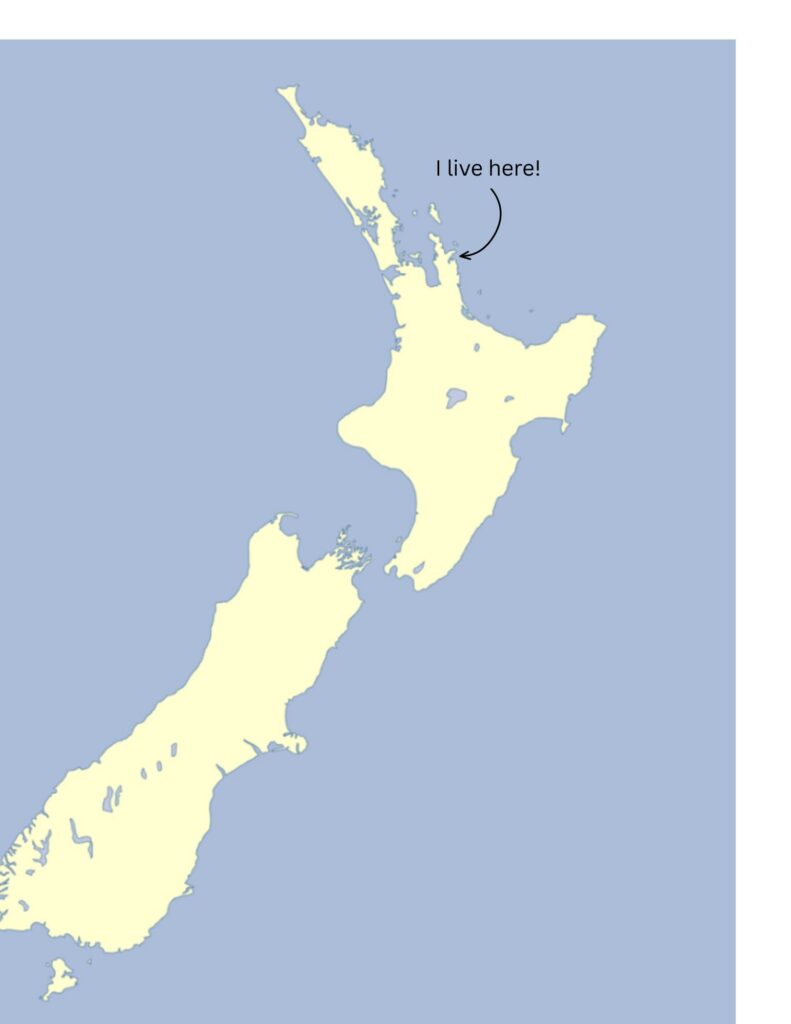
Okay, first things first. Here is New Zealand on a world map:
Don’t laugh. It’s such a big problem that New Zealand Tourism put out this video starring then-Prime Minister Jacinda Ardern and Rhys Darby, and John Oliver covered it in this hysterical three-minute clip. There’s even an entire Wiki page and subreddit solely dedicated to maps that have completely forgotten about New Zealand.
Now that we’ve confirmed that it exists, let’s talk about this remarkable island nation!
Aotearoa New Zealand Geography
NZ is in a region of the world called Oceania, which includes 14 countries, primarily Australia, New Zealand, and numerous Pacific island nations like Fiji, Papua New Guinea, and Samoa. Contrary to what many people imagine, New Zealand and Australia aren’t actually *that* close. The closest point between Australia’s mainland and New Zealand’s mainland is about 1,200 miles (2,000 kilometers) across the Tasman Sea. To put it in perspective for my American friends, that’s roughly the distance between Boston, Massachusetts and Jackson, Mississippi.
As the crow flies, New Zealand is about 1,429 miles (2,300 kilometres) south of the Pacific island nations of New Caledonia, Fiji, and Tonga, and, at about 3,025 miles (4,868 km ) it is the third-closest country to Antarctica. Yep: NZ really is in the middle of nowhere!
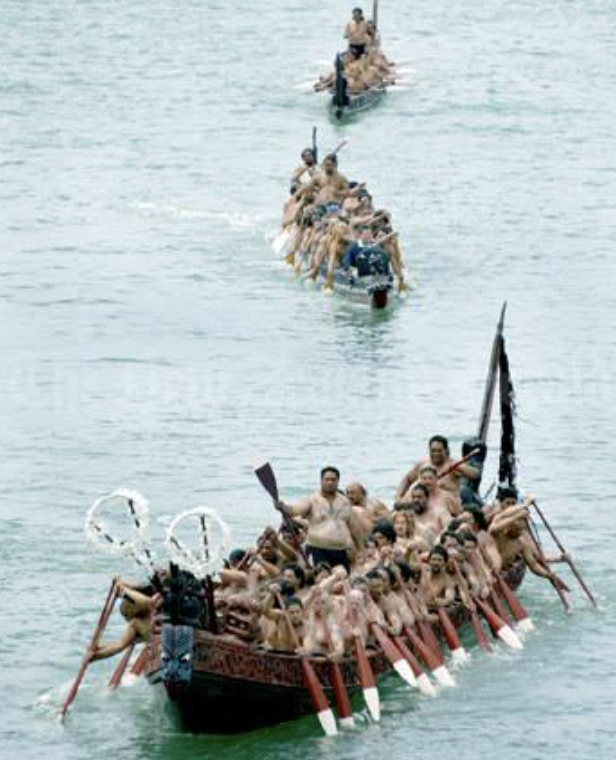
New Zealand consists of two main islands, the North Island and the South Island, and more than 600 (much, much) smaller islands. The North and South Islands of NZ are only 13 miles (23 km ) apart (fun fact: the northernmost point of the South Island is slightly further north than the southernmost point of the North Island). These islands are the southernmost Polynesian islands, the Hawaiian islands being the northernmost. According to Māori tradition, the country got its shape when the demi-god Māui went out to sea in a waka–canoe–and caught an enormous fish; the North Island is in the shape of the fish, and the South Island in the shape of his canoe.
The land area of the entire country of New Zealand (103,000 sq. miles) is almost exactly the same land area as Colorado (104,000 sq. miles). NZ is just shy of 1,000 miles long and 250 miles across at its widest point, and nearly 30% (!!) of its land is protected as conservation land or national park, compared to just 13% of the U.S. And in NZ, you are never more than 80 miles (128 km) from the ocean!
The population of NZ is around 5.1 million, roughly the population of Alabama. There are approx. 30,000 Americans who live in NZ (well; now there’s 30,001 😊).
Wellington–not Auckland or Christchurch–is the capital of New Zealand (it’s the southernmost capital in the world!). It’s located at the southernmost tip of the North Island and was chosen as the capital in 1865 in part because of its central location between the North and South Islands. With approx. 1.8 million residents, Auckland is the largest city in NZ followed by Christchurch, then Wellington.
Oh, and the “there are more sheep than people” thing is true: there are 5.1 million people….vs. 25.3 million sheep!🙍🐑🐑🐑🐑🐑
AotearoaNew Zealand Flora & Fauna
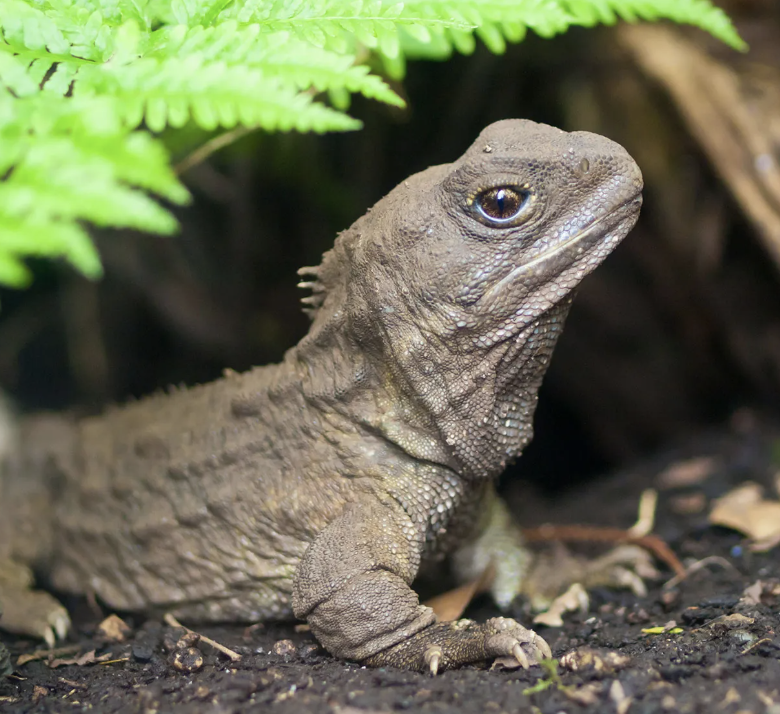
Due to its extreme isolation, NZ has one of the highest rates of endemism in the world; that is, one of the highest rates of plants and animals that are found nowhere else on earth. This includes such creatures as the tuatara, a prehistoric ancient reptile; kakapo, the world’s largest and only flightless parrot; wētā, a giant cricket-like insect; and of course the kiwi, NZ’s famous shy, nocturnal, flightless, and endangered national symbol. Bats are NZ’s only native land mammals.
KakapoWētāKiwiTuatara
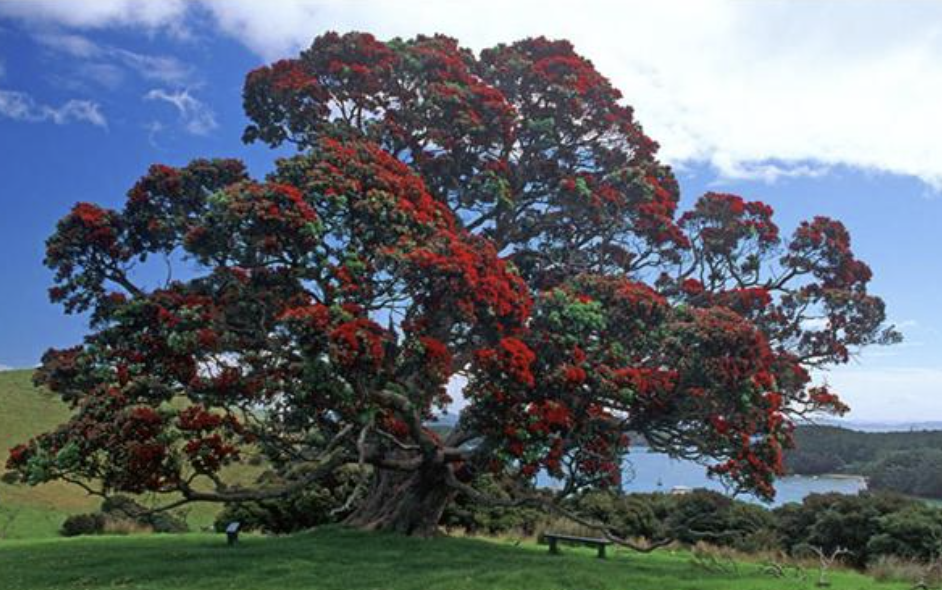
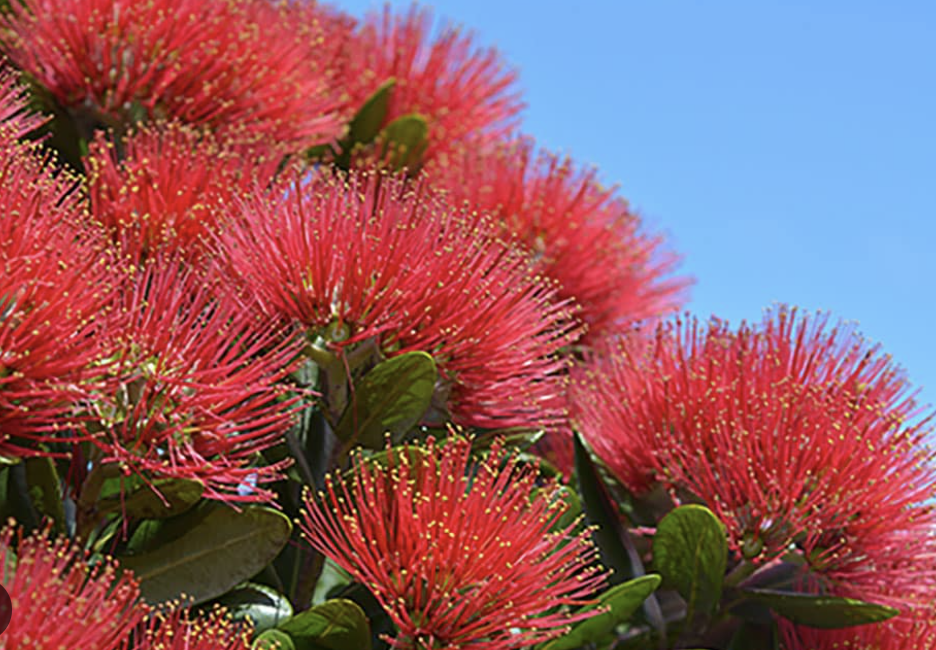
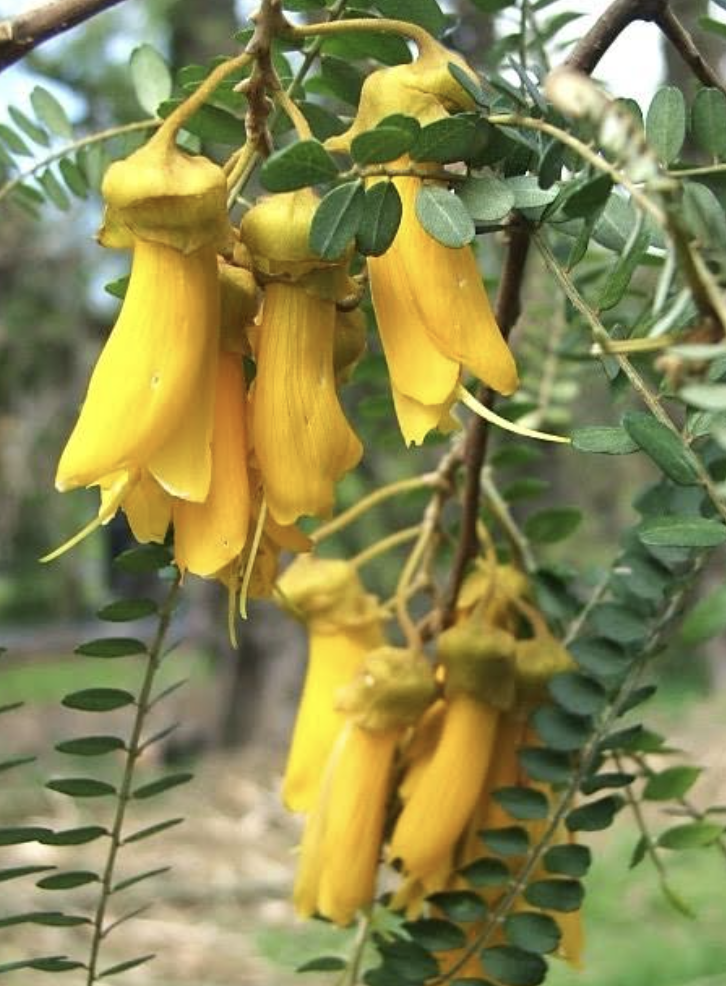
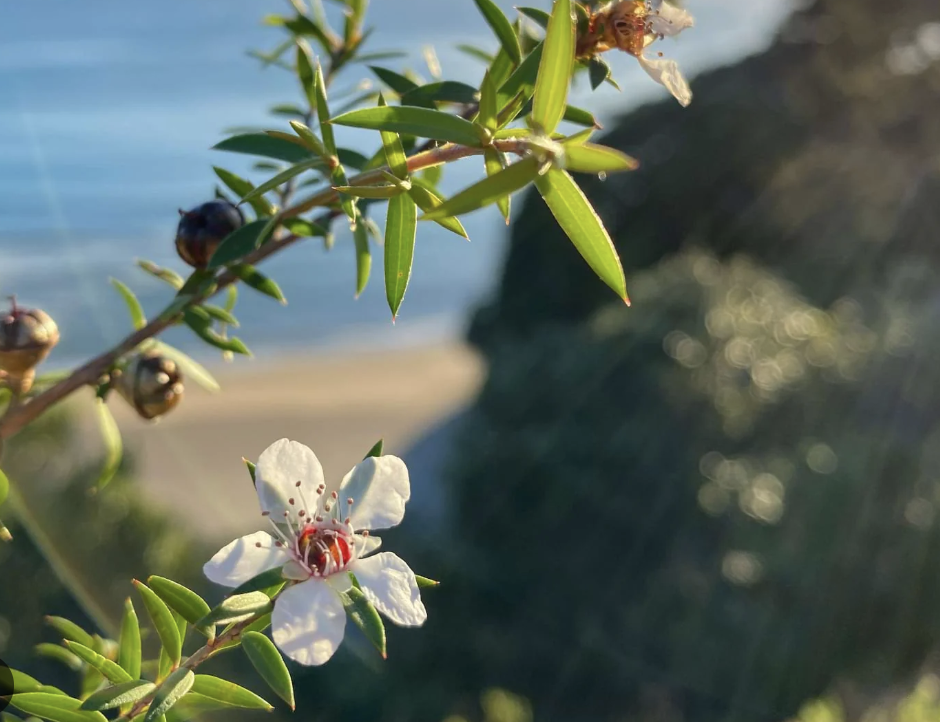
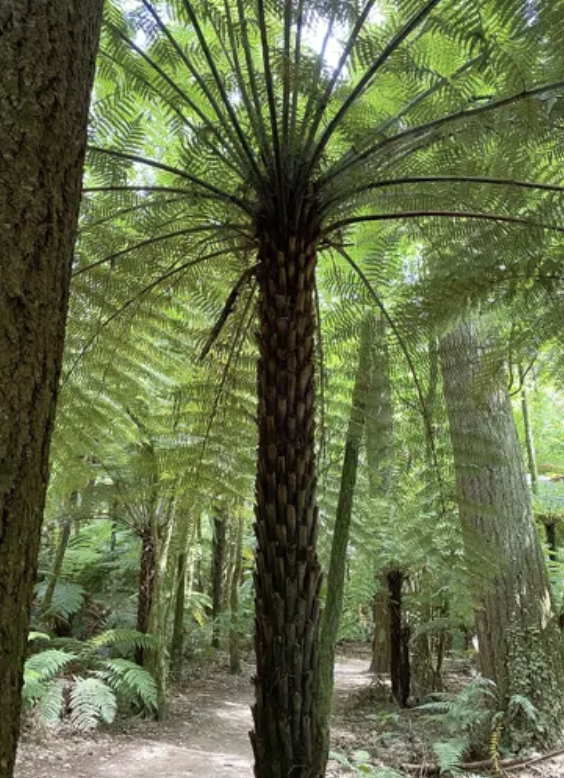
80% of NZ’s trees and plants are endemic–only found in NZ–such as the magnificent pōhutukawa, the stately kauri, and the elegant kōwhai trees, as well as mānuka, kānuka, and hebe. There are over 200 kinds of ferns alone! You can see a few of NZ’s native flora here, at the Department of Conservation.
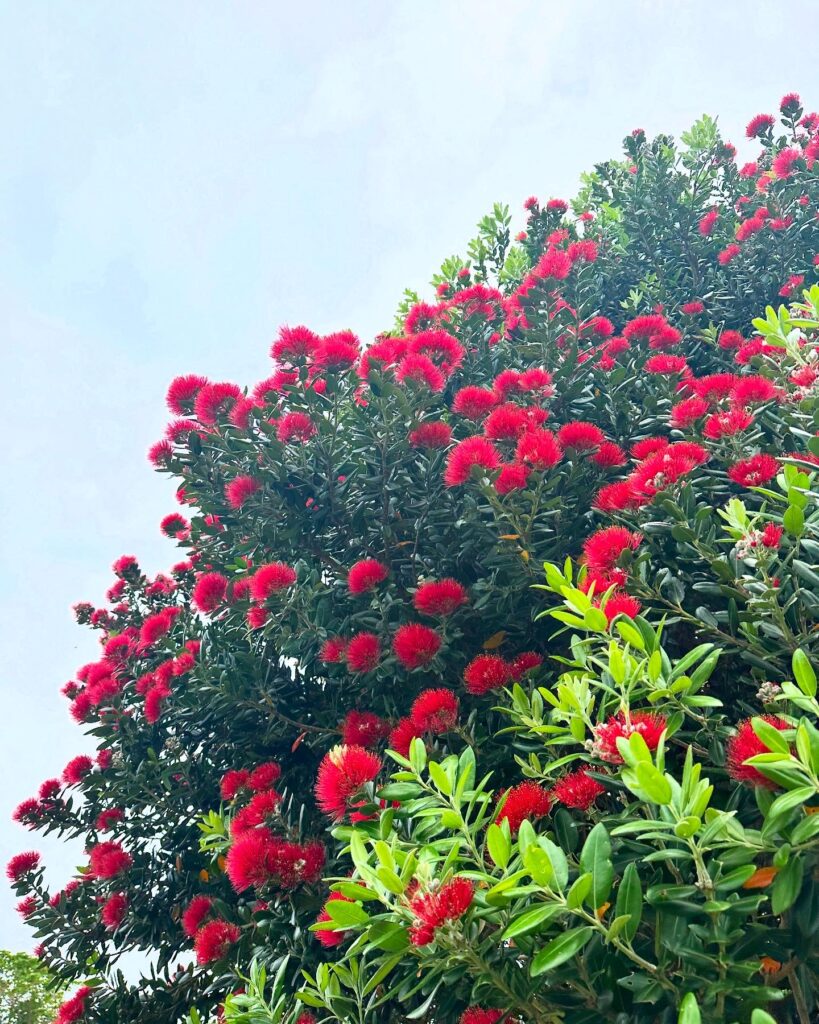
Pōhutukawa, aka the NZ Christmas TreePōhutukawa blossomKōwhai (pron. “ko-fye”)Mānuka, whose nectar produces the world-famous mānuka honeyPonga, NZ’s beautiful silver fernThe back side of ponga leaves really are silver!
NZ has the highest animal-to-human ratio in the world: out of all the living creatures in the country, humans make up only 5% of the population. NZ was also the last country in the world to be populated by humans. And despite its relative “close” proximity to Australia, NZ (thankfully) lacks all of Australia’s deadly animals. And there are no snakes! At all! Anywhere! 🚫🐍 .
New Zealand has an amazingly varied climate, ranging from subtropical in the north to alpine conditions in the south, with glacial fjords, soaring alpine peaks, rainforests, and geothermal wonders such as geysers and hot pools. I can’t emphasize enough how stunning this country is!
Māori, the tangata whenua of Aotearoa
Māori are the Indigenous people–or the tangata whenua (the people of the land)–of Aotearoa New Zealand. Aotearoa, the Māori name for New Zealand, is widely translated as “The Land of the Long White Cloud.”
The simplest way I can explain to a fellow American how to pronounce Aotearoa is “Ow-tay-ro-ah”. And the simplest way I can explain to a fellow American how to pronounce Māori is “Maw-ree”. It is not pronounced “May-or-ee.” Think two syllables, not three. Maw👏🏻-ree👏🏻. The actual pronunciation of both Aotearoa and Māori involve a beautiful little trill of the “r” that is difficult to master and even more difficult to try and explain using the written word. It’s much more beautiful than “Maw-ree,” but “Maw-ree” is passable. Just please don’t say “May-or-ee.”
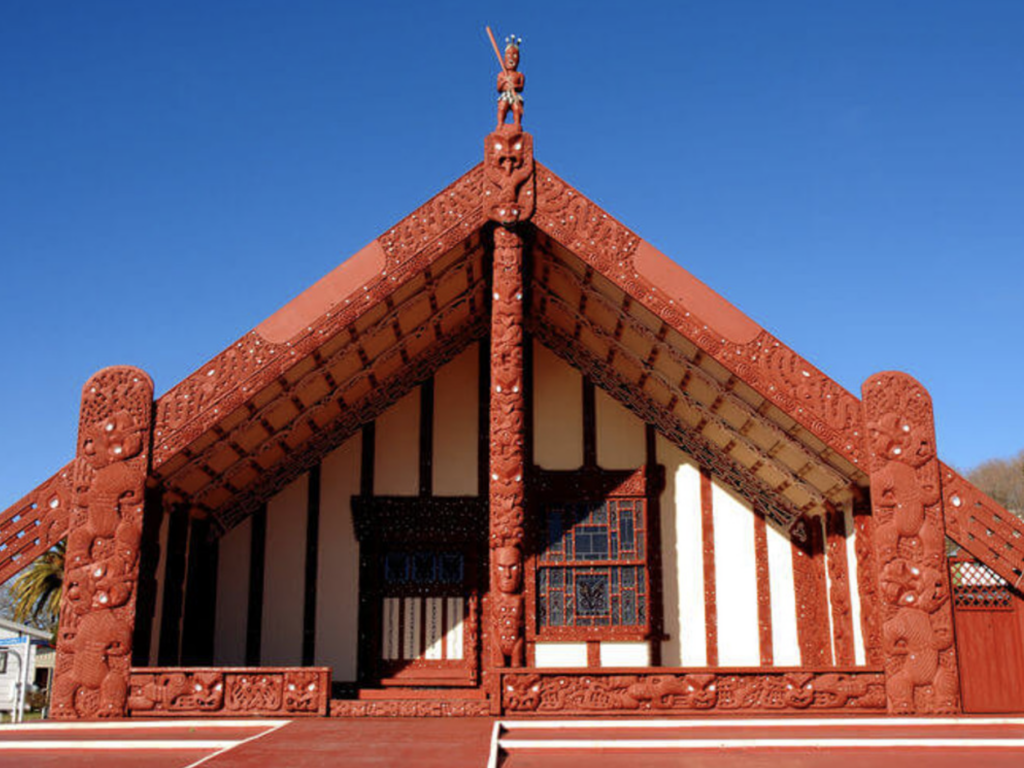
Ta moko, the sacred practice of Māori tattoo, the revival of which began over the last few decades.A marae (“mah-rye”), a traditional, sacred meeting ground.Example of a waka (canoe)
Te reo Māori (Maw👏🏻-ree👏🏻!), often shortened to just te reo, means “the language of Māori.” I was delighted on my first trip here to see how many things are written in both English and te reo. Billboards, public announcements, slogans, public restrooms (wahine (woman) and tane (man)), packaging in the grocery store, etc. Te reo is taught in many schools here, and some universities offer tuition-free te reo Māori classes. I’ve just started my own te reo journey, which I am finding equal parts overwhelming and fascinating. There are only 15 letters in the Māori alphabet: five vowels (a, e, i, o, u) and ten consonants (h, k, m, n, ng, p, r, t, w, wh), two of which are digraphs (two letters that combine to form one sound): wh and ng. Every word, and most syllables, in te reo end in a vowel. How cool is that!
There are many towns in New Zealand, especially on the North Island, whose names begin with the digraph “Wh.” In many regions of New Zealand, “wh” is pronounced much like an “f” sound, although pronunciation varies among iwi (tribal nations) and regions. Within a few hours of where I live, there’s Whangapoa (“Fang-a-po-ah), Wharekaho (“Fairy-kah-ho”), Whenuakite (“Fen-oo-a-key-tay”), Whangamata (“Fang-ga-mah-tah”)….and of course my town of Whitianga (“Fitty-enga,” or just “Fitty” for short).
I have a lot more I want to share with everyone about Māori culture and te reo, but I’ll save that for a future post.
On to….
NZ Government & Politics!
(A note before we begin: this is, obviously, the CliffsNotes version of New Zealand history and politics. Entire books, lectures, and university courses have been written about these topics. This is merely my attempt at providing a respectful and concise overview).
Māori ancestors arrived on waka–canoes–from Pacific islands between roughly 1320 and 1350 CE. NZ was formally established as a British colony in 1840.
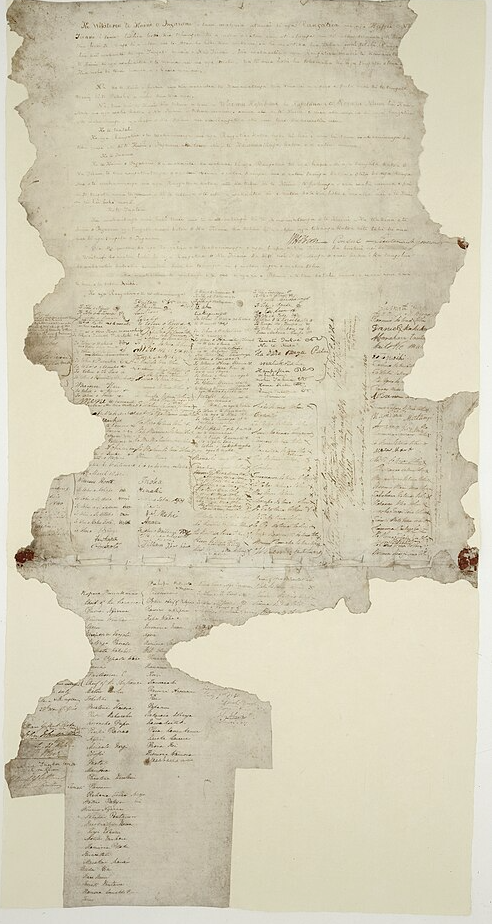
The Treaty of Waitangi (Te Tiriti o Waitangi), so named for the place where it was first signed on February 6, 1840, is considered to be New Zealand’s founding document. The Treaty is an agreement, in te reo Māori and English, that was made between the British Crown and around 540 Māori rangatira (chiefs). The Treaty is a source of major ongoing conflict, as the Māori and the Crown understood and interpreted it quite differently, leading to many of its promises being breached. As stated on Teara.govt.nz—the online Encyclopedia of New Zealand—“The English treaty and the te reo tiriti held different meanings. Māori and Pākehā therefore had different expectations of the treaty’s terms. Ever since, resolution of these differences has presented New Zealand with challenges.”
Since 1974, February 6–Waitangi Day–has been a public holiday marked with nationwide ceremonies, demonstrations, protests, and discussions.
NZ became a fully independent, sovereign state in 1947. It is a constitutional monarchy, meaning the Sovereign (who is also the British monarch) is their Head of State, while the country is governed by a democratically elected Parliament led by the Prime Minister.
In 1893, New Zealand became the first country in the world to give women the right to vote (speaking of women voting in NZ, I’m eligible to vote in elections this November–!!!). When Jacinda Ardern, the previous Prime Minister of NZ, was elected at the age of 37, she became the 9th youngest Prime Minister in world history.
New Zealand has a publicly funded healthcare system. Most essential healthcare is free or significantly subsidized for eligible residents, although dental care for adults is generally not covered (who decided that teeth aren’t part of the body?!). Private health insurance is also available.
Universities here are not, as I once believed, free. The New Zealand Government subsidises the fees of domestic students, so they generally pay a lower rate than international students. A domestic student is someone who is a New Zealand citizen or permanent resident or an Australian citizen residing in New Zealand.
Notable Kiwis
NZ is, rightfully so, fiercely proud of its famous Kiwis, including mountaineer Sir Edmund Hillary; movie directors Taika Waititi and Sir Peter Jackson; actors Sam Neill (pictured here), Lucy Lawless (aka Xena the Warrior Princess), and Karl Urban; country music singer Keith Urban (no relation to Karl), and musicians Neil Finn (Crowded House), Bret McKenzie & Jemaine Clement (Flight of the Conchords), Lorde, and Kimbra.
By the way, “Kiwi” can mean three things in New Zealand—the native bird, the fruit (although locals usually say kiwifruit), or a New Zealander. 🥝
And finally, some fun facts about Aotearoa New Zealand!
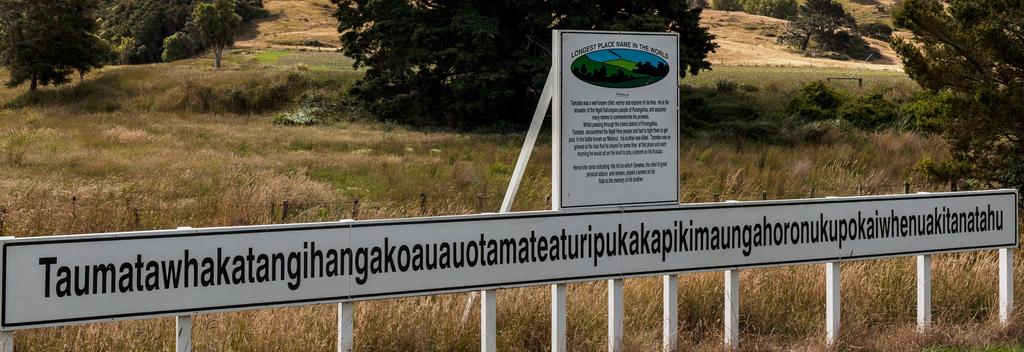
Aotearoa NZ is home to the steepest road in the world (Baldwin Street in Dunedin) and the longest town name in the world (85 letters long): Taumatawhakatangihangakoauauotamateaturipukakapikimaungahoronukupokai whenuakitanatahu. Its translation from te reo Māori is roughly: “The place where Tamatea, the man on the big knees who slipped, climbed and swallowed mountains, known as the land eater, he played the flute to his loved one ”.
The three official languages of New Zealand are English, te reo Māori, and NZ sign language.
NZ is home to the world’s only carnivorous snail (the pūpūharakeke), the heaviest insect (the giant wētā), and the smallest dolphin (Hector’s dolphin). There are more species of penguin found in NZ than any other country.
A non-comprehensive list of things invented in New Zealand and/or by New Zealanders: disposable syringes, tranquilliser guns, childproof medicine containers, the jetpack, the amphibious boat, electric fences, bungee jumping, refrigerated shipping, and jogging (yes, really).
NZ is the world’s largest exporter of milk and dairy products by dollar value (despite only ranking 9th in raw milk production).
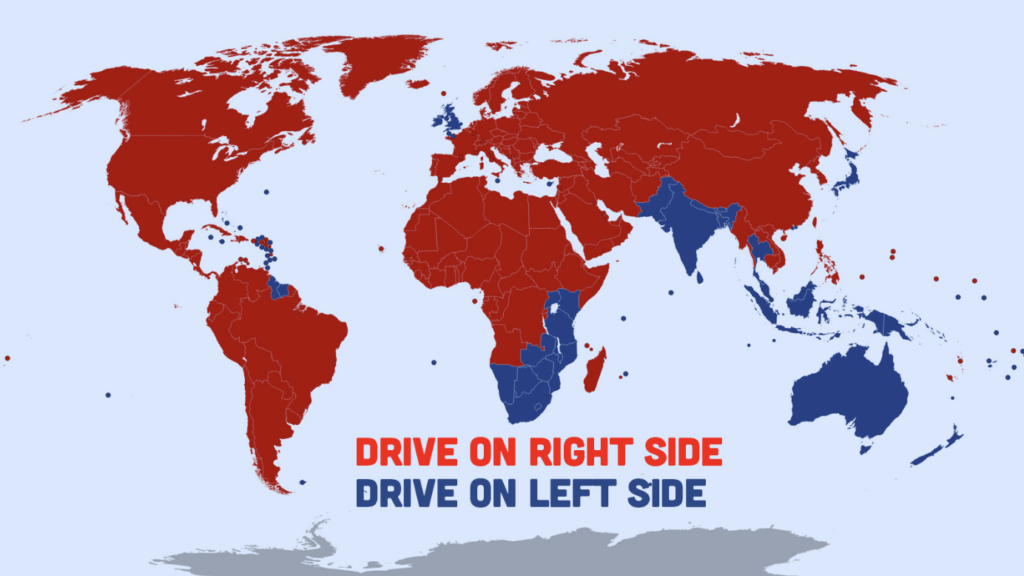
They drive on the left in NZ, along with about 35% of the world population (I’ll write a separate post dedicated to the history of why some countries drive on the left and some on the right. It’s fascinating!). Because NZ imports cheap second-hand cars from Japan, they have the highest car ownership rates in the world, with 869 cars for every 1000 people.
Ngā mihi nui for reading all of this! It means a lot to me when people take an interest in my beautiful, fascinating, unlike-any-other-place-in-the-world adopted country.
A few weeks ago–on Sun, Sept 28th–5.3 million Kiwis and I set our clocks ahead an hour as Daylight Saving Time ended and we “sprang forward” into spring.
Yep: Daylight Saving Time is a thing here, too. I was extremely displeased when I found this out.
The look on my face when I first found out that NZ observes DST.
The first Sunday in November, when we in [most of] the United States “fall back an hour,” has long been my least favorite day of the year. You’re staring down the barrel of an interminably long New England winter, but hey, know what would help? What if we make it so that it’s pitch [expletive] black at 4 PM?
If you are able to picture the level of my excitement at the thought of living in a sane, rational country that didn’t arbitrarily disrupt its citizens’ circadian rhythm twice a year, you can also visualize the level of abject horror I experienced when I found out thatthey do. They do observe Daylight Saving Time in New Zealand. In fact, Daylight Saving Time was first proposed in 1895 IN. NEW. ZEALAND.
I always assumed that the maddening tradition of changing the time twice a year was a uniquely American thing, but it’s not. In fact, about a third of countries recognize DST.
Here’s a map of countries which observe Daylight Saving Time:
Blue = Observes DST around the Northern Hemisphere summer, orange = Observes DST around the Southern Hemisphere summer. Source: Wikipedia.
So yeah, New Zealand does the whole DST thing too. But get this: they observe it in April and September, as opposed to March and November like we do in America. On the first Sunday in April they fall back an hour because it’s going into their winter, and the last Sunday in September they spring ahead an hour because it’s going into their springtime, whereas in the States, we jump ahead an hour on the second Sunday in March as we enter springtime and then fall back an hour on the first Sunday in November when we’re heading into seasonal depression winter.
So loosely speaking–don’t do the math on this–the Eastern Time Zone of the United States, where I’m from, is 18 hours behind New Zealand for about 2.5 months, then 17 hours behind for three weeks (give or take), then 16 hours behind for roughly five months, then looping back to 17 hours behind for like five weeks, and then back to 18 hours behind for the remaining 4-ish or so months of the year (hey, I said don’t do the math).
Does your head hurt yet? Welcome to my world these past five years. Long-distance relationships, both romantic ones and family/friend ones, are hard enough to maintain as it is, let alone 9,300-mile/15,000km-long-distance ones, and then add a whopping 18, 17, 16, 17, or 18 hour time difference which changes four times a goddamned year.
The changing of the clocks a few weeks ago led me to do a deep dive on Daylight Saving Time, which included the discovery that it’s actually “SavinG” time, not SavingS” time. Where did this idea even come from, and why are we still doing it? I’m glad you asked! Let’s go on a Daylight SavinG Time adventure together!
As I mentioned before, the idea for Daylight Saving Time was originally proposed in New Zealand. George Hudson, a British-born entomologist living in NZ at the time, came up with the idea because it would give him more sunlight by which to collect bugs (I swear I’m not making this up). In 1895, he presented a paper to the Wellington Philosophical Society proposing a two-hour daylight-saving shift. The idea was well-received, though nothing was actually done about it (so I guess George Hudson isn’t the true villain here, but still, he pitched the idea first). Then a different guy, William Willett, a Brit, living in England this time, independently came up with the exact same idea (what the hell, Brits!!), although his motivating factor for making everyone change their clocks twice a year was not so that he had more time to hunt for insects; it was so that he had more time to play golf. So there you have it: we’re all forced to change our clocks twice a year thanks to a bug nerd and a golf enthusiast.
George Hudson, loser bug nerd (L), William Willett, selfish golf enthusiast (R)
DST was first implemented in the US with the Standard Time Act of 1918, a wartime measure during World War I in the interest of adding more daylight hours to conserve energy resources. It was repealed the following year, but implemented again during World War II for the same reasons. After WWII, local jurisdictions were free to choose if and when to observe DST, until the Uniform Time Act came along in 1966, which standardized DST. It is therefore a myth that DST was created in the States for the benefit of farmers; in actuality, many farmers have been lobbying against DST since it was first implemented. As stated on Wiki: “The factors that influence farming schedules, such as morning dew and dairy cattle’s readiness to be milked, are ultimately dictated by the sun, so the clock change introduces unnecessary challenges.”
New Zealand, on the other hand, first observed daylight saving in 1927, although the dates on which it occurred, and the amount of time that was changed, varied wildly over the following years. They just could *not* make up their minds about it.
In 1941, New Zealand summer time was extended by emergency regulations to cover the whole year.
In 1946, New Zealand summer time (12 hours in advance of GMT) was adopted as New Zealand standard time. Daylight saving time was effectively discontinued at this point.
In 1974, daylight saving was trialled again, and introduced in 1975. Daylight saving time is 1 hour ahead of New Zealand standard time.
1985 — Public attitudes (pfft, I can tell you what my public attitude would have been) were surveyed and over the next few years the period of daylight saving time was extended twice.
2006-07 — Following public debate and a petition presented to Parliament, the period of daylight saving was extended to its current dates. New Zealand observes daylight saving from the last Sunday in September to the first Sunday in April.
So anyway, yeah: New Zealand has it too.
“Fun” facts about Daylight Saving Time!
The first implementation of DST was by Port Arthur in Ontario, Canada, in 1908, but only locally, not nationally. The first nation-wide implementations were by the German and Austro-Hungarian Empires, both starting on April 30, 1916.
Roughly half of all countries have at some point observed Daylight Savings Time. In the past decade alone, about a dozen countries have done away with the practice, including Iran, Namibia, Russia, Turkey, and Uruguay.
Not every part of every country who observes DST observes DST. Only certain parts of Brazil change their clocks twice a year, and out of the six states and two territories of Australia, two states and one territory do not observe DST. In the States, Hawaii doesn’t change its clocks, all of Arizona except the Navajo Nations doesn’t change its clocks, and Indiana just started changing its clocks in 2006. And 5 of the 16 United States territories don’t observe it (and oh yeah, there are 16 US territories, apparently?).
Egypt stands out as the only African nation with Daylight Saving Time. It also has the distinction of having ended Daylight Saving in 2014 and then bringing it back again in 2023.
The Diomede Islands, located in the center of the Bering Straight between Alaska and Siberia, are made up of two islands: Big Diomede, which belongs to Russia, and Little Diomede, which belongs to the United States. The two islands are separated by the International Date Line, so although they are only 2.4 miles apart, Big Diomede (known as “Tomorrow Island”) is 20-21 hours ahead of Little Diomede (nicknamed “Yesterday Island”).
Since I was in daily contact with a certain Kiwi for the approximately 1,280 days that we were long-distance, I became adept at glancing at my watch in the States and knowing exactly what time it was in New Zealand. But my friends and family haven’t had as much practice. So before I left home, I whipped up these handy-dandy reference charts for people to hang on their fridges. Can someone just add “Auckland” to the world clock app on their phones? Obvs. Is it as fun as referencing a cute, lovingly made handmade chart? Pffft.
Here are the cheat sheets I gave people. The teeny tiny font in the bottom right corner explains when the time difference will change four times a year.
In case your brain isn’t full enough:
Back home in the States, Summer Solstice happens on June 20/21 and marks the longest day of the year (that is, the day with the most amount of sunlight). And Winter Solstice, December 21/22, marks the shortest day of the year (the least amount of sunlight). But because Earth’s two hemispheres are topsy turvy from one another, the Northern Hemisphere’s Summer Solstice is the Southern Hemisphere’s Winter Solstice. So while June 20/21 in the Northern Hemisphere is the lightest day it’s the Southern Hemisphere’s darkest one, and while December 21/22 marks the darkest day for the Northern Hemisphere, it marks the lightest day for the Southern Hemisphere.
And a fun mind bender: Stewart’s birthday is in July and mine is in December. We both grew up having wintertime AND summertime birthdays. 🙂🎂🙃
And this is where I sheepishly admit that I got residency three months ago and am just now writing about it. I’m so far behind on blogging that I missed posting about basically the most important achievement of this entire visa journey. 🤦🏼♀️
But my delay in this announcement doesn’t change the fact that I finally get to type this sentence:
My Partner of a New Zealander Resident Visa was approved on July 6th, making me a legal resident of New Zealand.
Somewhat amusingly, I wasn’t even in New Zealand when they finally granted me New Zealand residency. I was in the States for three months, working at my old job and spending time with family and friends, when the email came through. (Because I was out of the country when it was approved, it actually didn’t officially begin until August 22, when I got back to NZ).
The turnaround time from when I submitted the Partner of a NZer Resident Visa (Jan 6) and when it was approved (July 6) was six months to the day; Immigration’s website at the time I applied said that 80% of these visas are decided upon within 7 months, so it was right on schedule (Immigration updates its approximate turnaround time for each visa monthly).
This new visa allows me to continue living and working in NZ, and traveling in and out of NZ, for two years. After those two years are up on August 22, 2027, I can either:
1. Stay in NZ legally, forever, but never leave, or
2. Apply for the Permanent Resident Visa, which of course is the option I’ll go for. The Permanent Resident, which will be my last visa(!!!), is the cheapest ($315 NZD/$184 USD), easiest, and fastest (most are approved within 3 weeks) of them all. And then I’m good forever! (After five years of having Permanent Residence, I can–if I meet the criteria–choose to apply for citizenship. I’ll cross that bridge when I come to it).
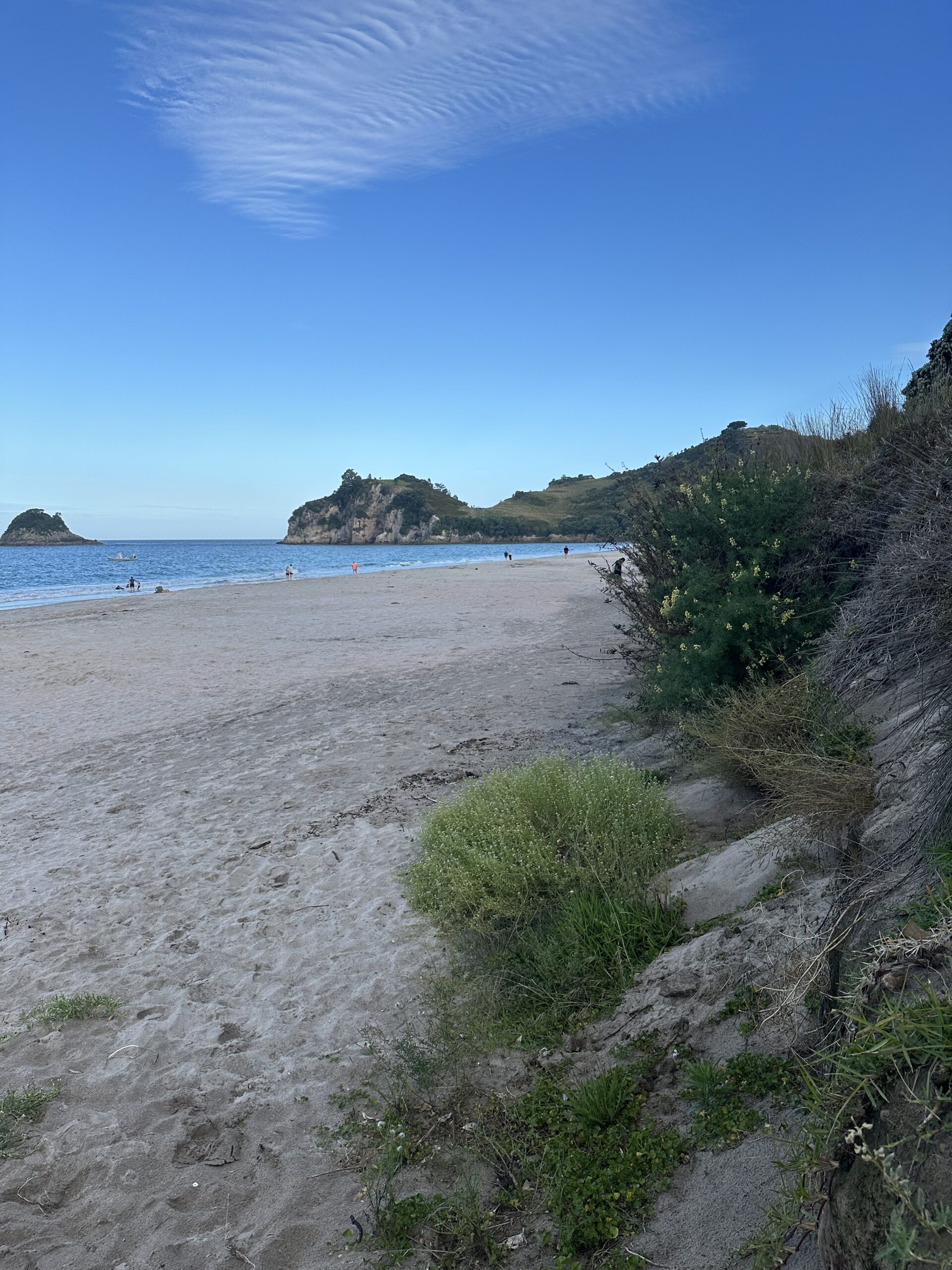
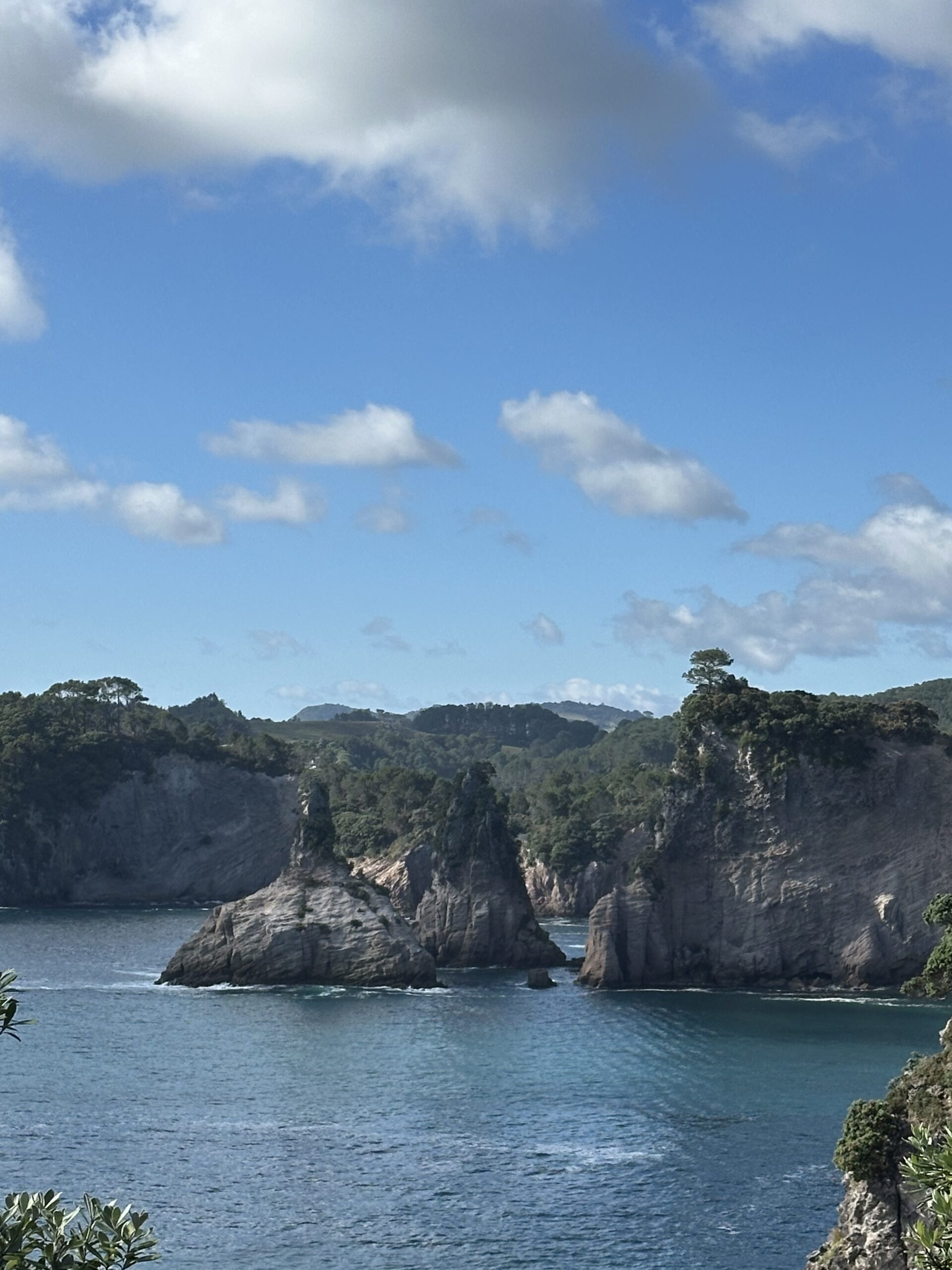
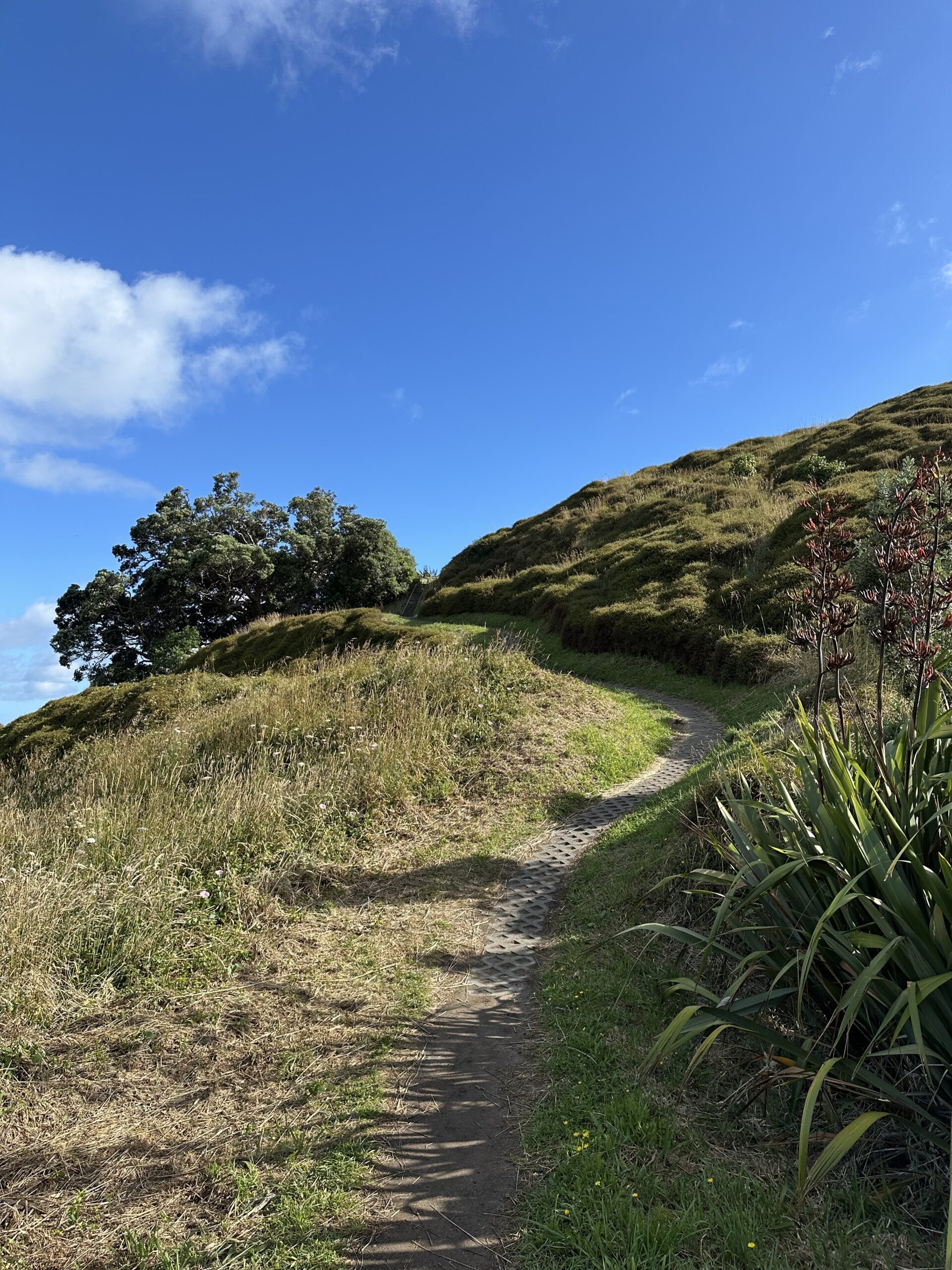
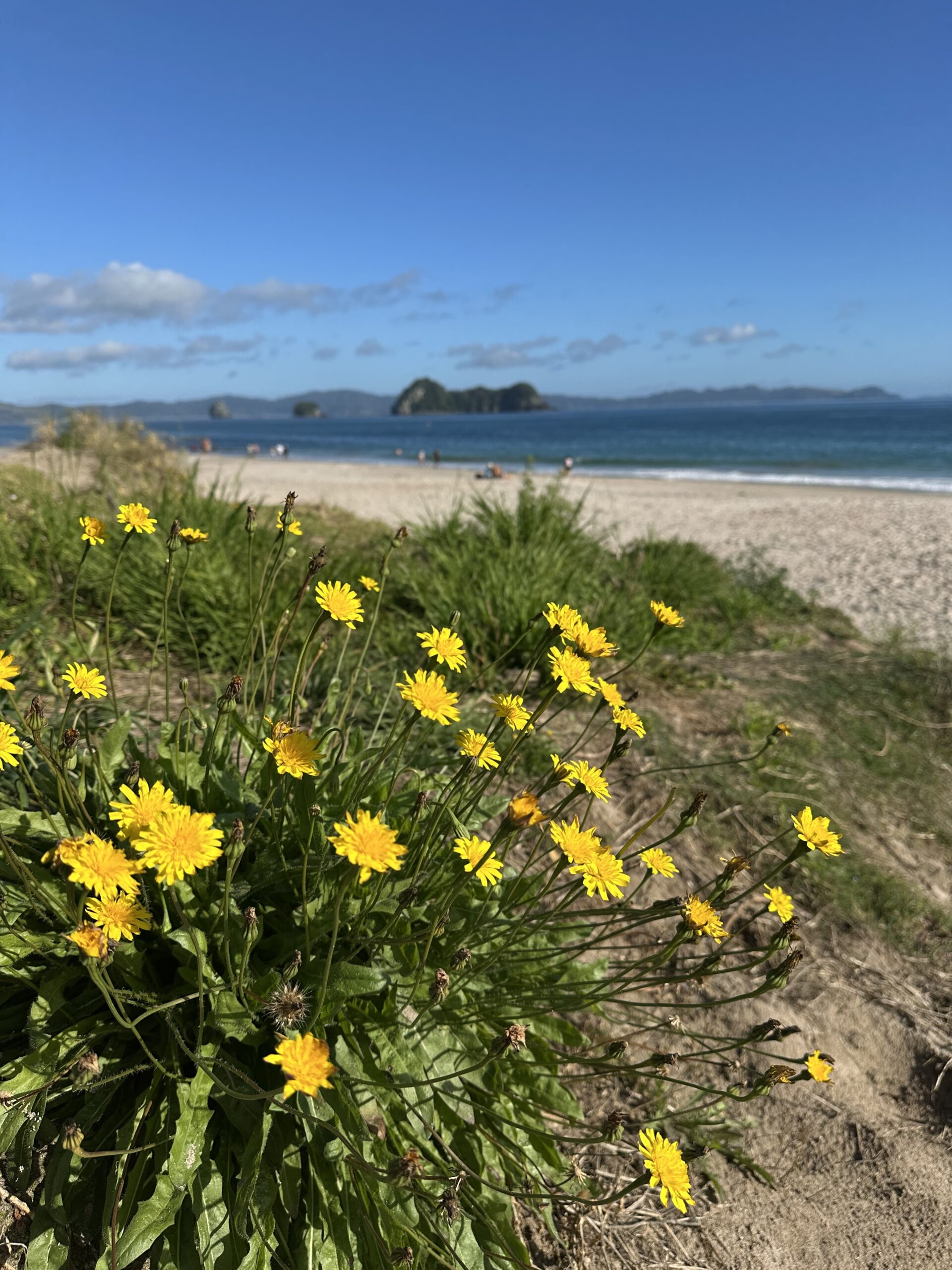
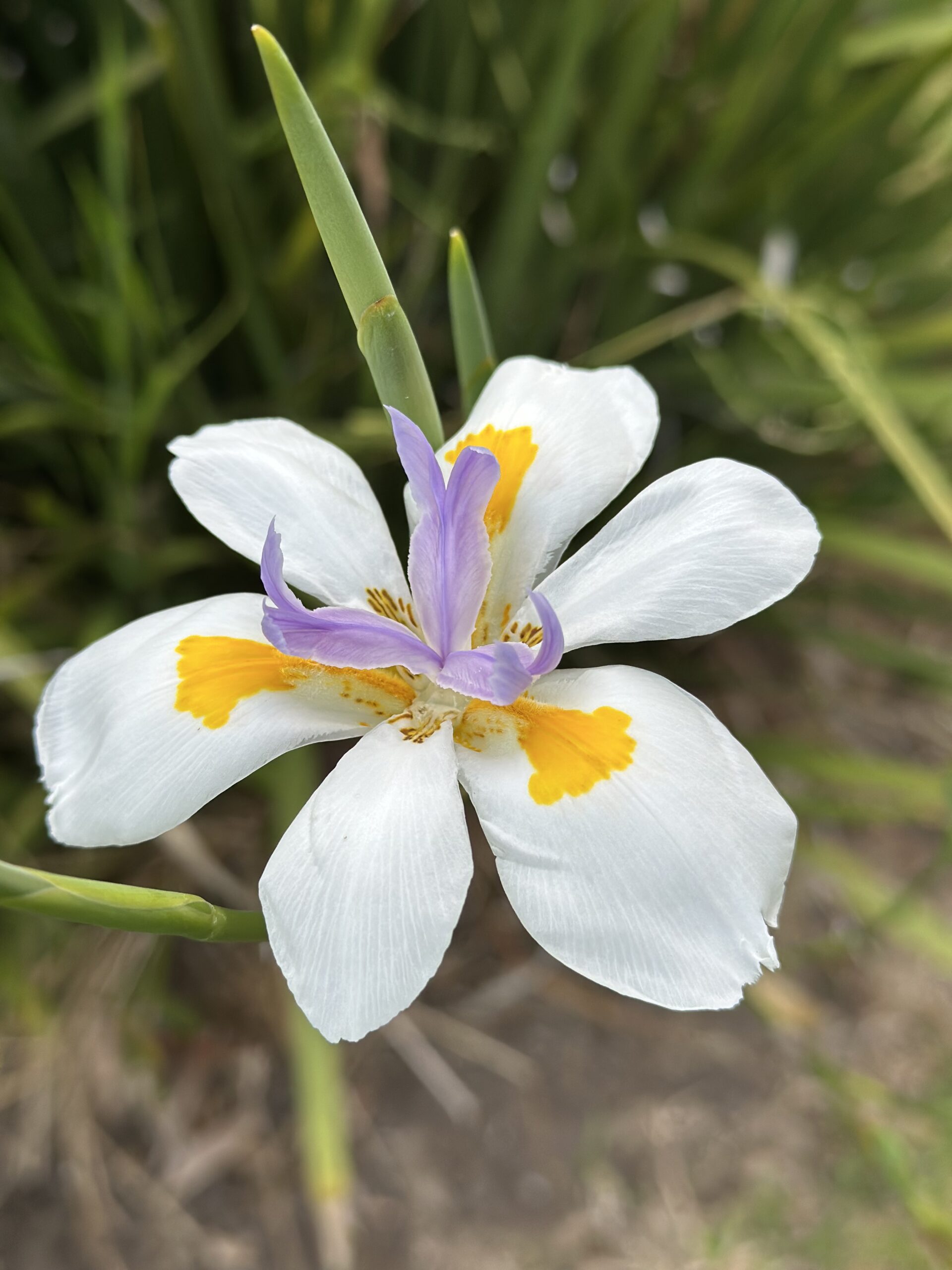
Pictures of gorgeous beach flowers to break up the blocks of text.
As I’ve mentioned in previous posts, you can’t apply for the Partner of a NZer Resident Visa until you and your Kiwi partner have been living together for 12 months. I applied a few days after Stu and I hit that mark–January 7, 2025. Because my first visa, the Partner of a NZer Work Visa, was due to expire on May 22, 2025, and my Resident Visa wouldn’t be approved until at least July 2025, I had two options: leave NZ before my Work Visa expired and return once my Resident Visa came through, or renew my Partner of a NZer Work Visa for the new tune of $1,630. I thought it was a no-brainer; I’ll just book a one-way ticket home to the States and wait it out while I spend time with my family and friends. Perfect!
Except that it wasn’t. I was advised against doing this by two separate immigration lawyers, both of whom told me that my decision to fly out of NZ, alone, on a one-way ticket without knowing when I’d be allowed to come back in wouldn’t be looked upon favorably by Immigration, since my entire application was based upon the strength of my partnership. This annoyed me greatly–why do two people have to be together constantly just to prove their commitment to one another?–but after thinking it through, I decided to go with their advice and re-apply for (and re-pay for) another Partner of a NZer Work Visa to cover me for the estimated 2-3 month gap between visas. It costs me $1,630 NZD ($951 USD), which is a hell of a lot of money to pay for 2-3 months, but I admit that it did give me peace of mind about going back to the States for a bit. The second work visa was approved on March 3 and was good for two years, giving me plenty of coverage.
On June 30, while I was back in the States, I got an email from a nice immigration officer named Stacey saying that she has been assigned to my application. (This is the only communication I’ve had from an actual person at Immigration; everything prior to this has been generic correspondence in the form of a PDF in my Immigration account inbox). Stacey was writing to ask why I left New Zealand on May 31, and for what purpose, and when was I returning, and why wasn’t my partner with me, and could I please respond to her within four days (all of this is information she was able to access since she has both of our passport numbers).
I was expecting this email. A Kiwi friend of mine has an American partner who is 15 months ahead of me in the same visa process. Like me, he was in the States while his Resident Visa was processing, and he’d received an email inquiring why he was abroad without his partner. My friend said Immigration would probably send me a similar email, and reassured me that I was doing everything by the book, my reasons for traveling were completely legitimate, and that I shouldn’t worry.
Don’t worry! Piece of cake.
Something that many of you already know about me is that I essentially exist in a perpetual state of heightened anxiety (“energetic” is a nice way of putting it; “neurotic and high strung” is also accurate), with a steady stream of worry always percolating in the background. Even when I’m going about enjoying my day, there’s always that simmering sense that something awful could definitely happen at any moment. And on the rare occasion I don’t have anything specific to worry about, my brain will kindly invent something for me. It’s like a backwards worry stone; my brain needs something to worry about just to soothe itself. I know; it’s messed up. Being a high-strung human does have its perks: I can do the work of 27 people in a day, I multitask like a champ, and if you want me to do something for you–oh, look, I already did it before you finished asking!! And it’s not like I feel constantly alarmed, just constantly…ready to panic at the drop of a hat. Increased productivity aside, it does suck that as soon as something even remotely unexpected or stressful happens, my entire being goes “OKAY, THIS IS WHAT WE’VE BEEN TRAINING FOR” and my brain has a ?!@#$!! heart attack.
So you can imagine how I reacted when this perfectly rational, friendly, and fully anticipated email from Immigration arrived in my inbox, asking very reasonable questions to which I had perfectly acceptable answers. My head went into fight or flight mode: they’re going to reject my application because I’m overseas, I’ll be out thousands of dollars, they’re going to ban me for life, and I can never see Stu or his kids or my NZ friends again. You know; a really rational response. 🙄
I immediately messaged the aforementioned Kiwi friend whose American partner is on the same journey, and she calmly (bless you, Molly) walked me through how to respond to each of Stacey’s questions, which I did. I didn’t hear back from her [🧠: PANIC], but 7 days later I got an email from Immigration with my Residency Visa attached.
For anyone who’s curious, here is what the visa looks like:
I still can’t fully believe it. It hits me in little moments, such as when Stu and I recently booked a weekend away and I reflexively reminded myself to add it to the (now-deleted) “Imm NZ Significant Events” list in the Notes app on my phone, and then remembered that I do not, ever again, have to keep a running tally of important events and their corresponding dates to submit to anyone as proof that our relationship is genuine. I can just…relax. [🧠: “LOL”].
I honestly feel like this all happened very fast (do any of you feel that way?). It seems like just yesterday that I started this blog–it was in fact Dec 2023–to chronicle this wild immigration journey, and I pictured myself writing updates for years and years and years. Technically this isn’t “done and dusted,” as they say here, until I get Permanent Residency in 2027, but by all accounts that’s practically a given once you get residency. This was the big one.
I’ve written a lot here, but I want to close with this: I vividly remember when I began seriously looking at moving to New Zealand. It was the US fall/NZ spring of 2019, about six months before I’d ever even set foot there. I was deep in the process of getting divorced, holding ideas of varying degrees of creativity and insanity up against my life to see if any of them could work. I could do anything I wanted to do, go anywhere I felt like going! I knew at the time that I should have felt “free,” but all I could feel was “f**king terrified.” To give myself some breathing room, I went to my local library, logged onto one of their computers, and googled “how to move to new zealand.” I landed for the first time on the Immigration New Zealand website I would come to know by heart. Apply now to visit, study, work or live in New Zealand, the homepage said, and it then guided me through a series of dropdown menus. I am a citizen of [United States of America]. I want to [live permanently] in New Zealand. I do [not] have a job offer. I clicked “Find Visas” and fewer than a half dozen options came up, most of them completely out of reach. I checked the “Skilled Shortages” list, knowing already I wouldn’t be on it. I left the library feeling despondent and discouraged.
It’s strange now, looking back, to realize that what I once thought was impossible was simply something I hadn’t done yet.
Aroha/Love, H. ❤️
“Start by doing what’s necessary; then do what’s possible; and suddenly you are doing the impossible.” – Francis of Assisi
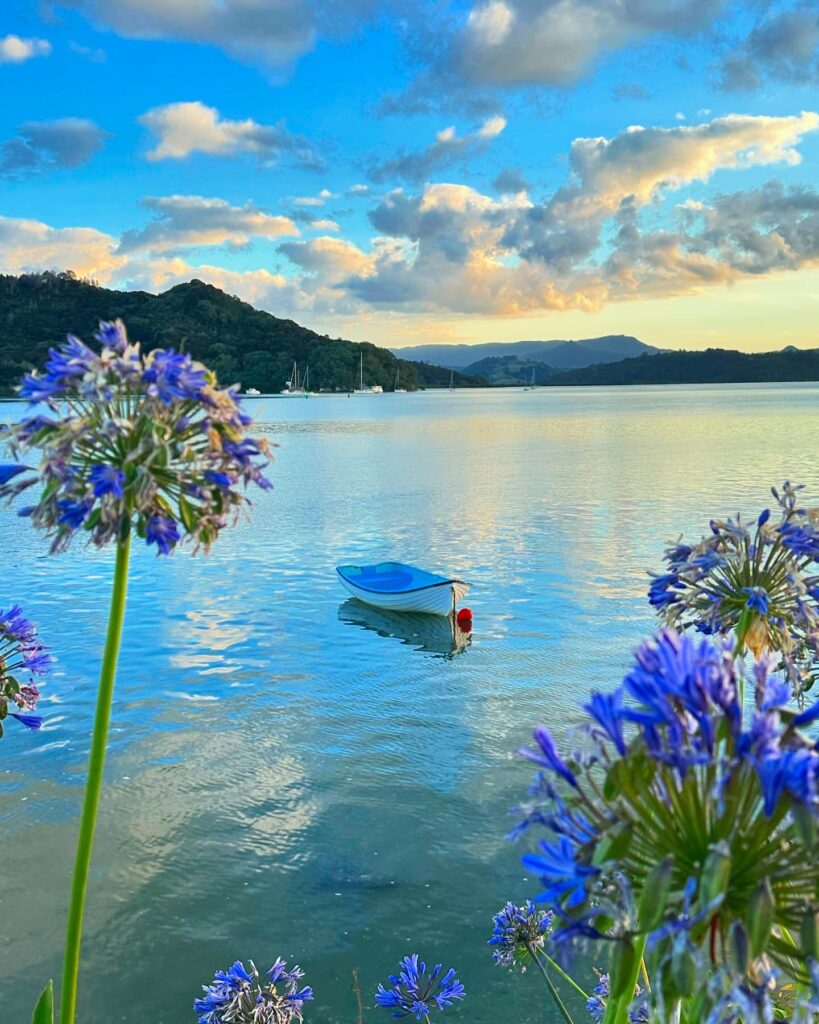
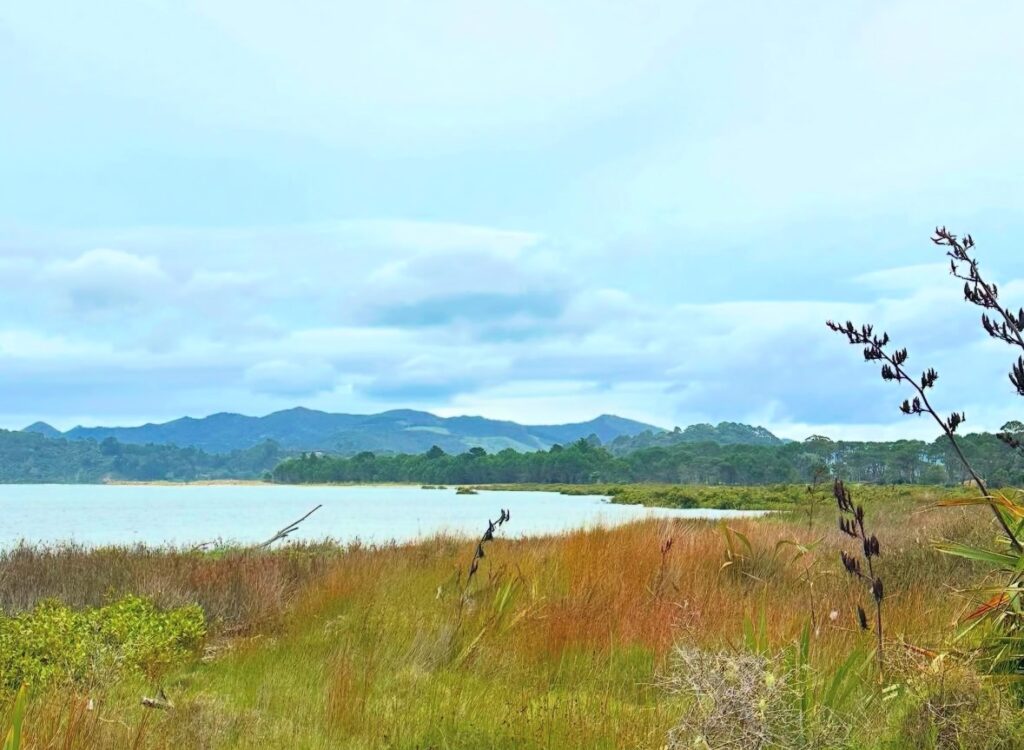
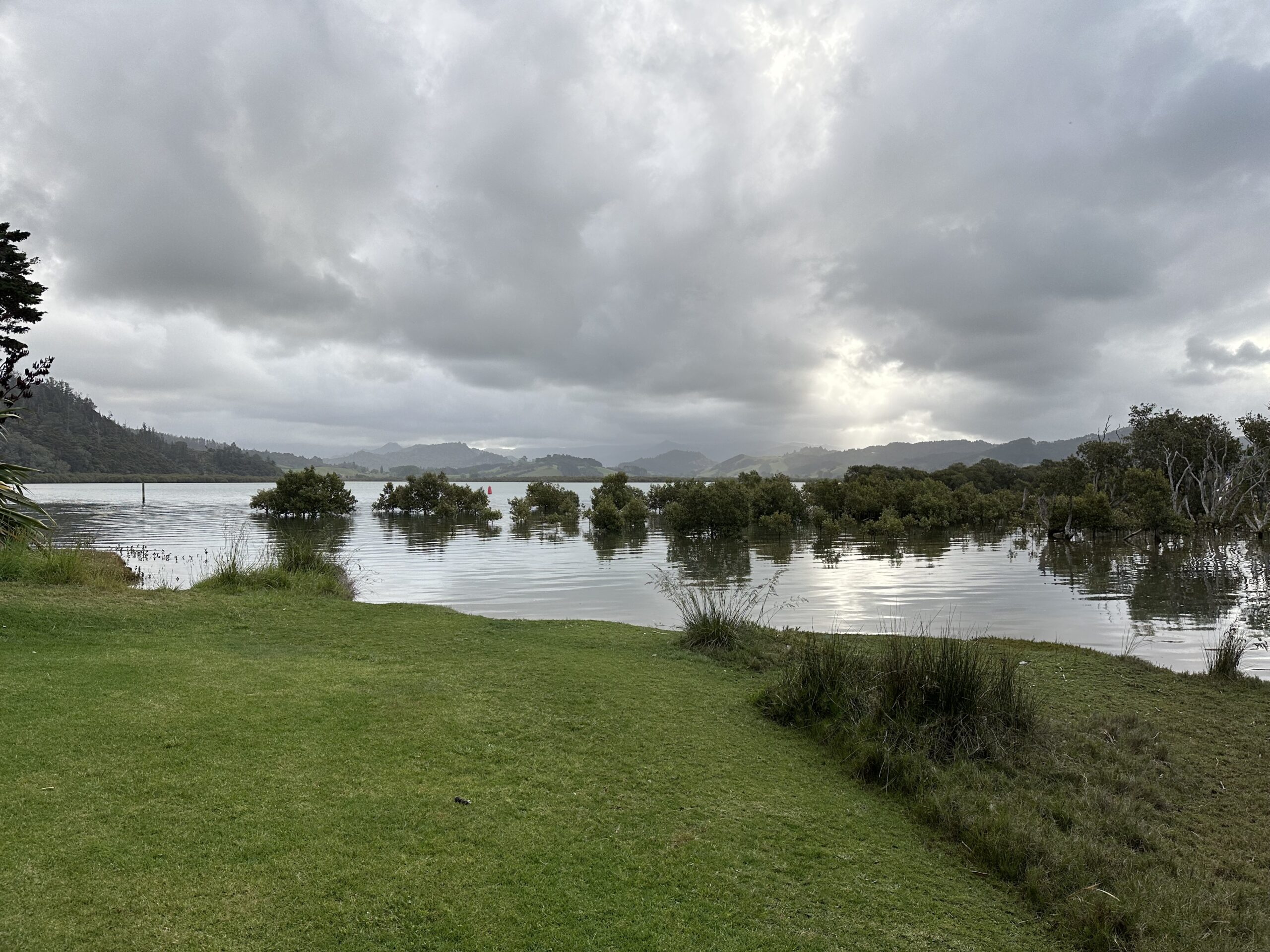
Gorgeous early evening walk home along the estuary. New Zealand often looks like a painting to me.
A few days ago, I received an email from Immigration New Zealand inviting me to complete a “customer experience survey” for the chance to win $100 NZD.
Yes, really. I thought it was as weird as you probably do, but it’s legit. There’s a brief page about it on INZ’s website explaining that they arbitrarily choose a selection of applicants and invite them to share their feedback. The email said that the survey was conducted by a “third party independent research company” called Gravitas OPG Limited, and assured me that Pfffft, of course none of my responses would make their way back to them, Immigration NZ, the ones who are currently in the process of determining if I should be granted a Resident Visa that would allow me to continue to live and work in their country.
It seems like…not the right time to be asking me to give honest feedback.
After I have completed the process and gotten all the visas I need? Giiiirl, hit me up and I’ll spill the tea. ☕️💅🏻
But during the visa process? Like, as someone is actively reviewing my application for residency, and then my survey comes in to Immigration NZ “third party independent research company Gravitas OPG Limited,” and there’s a company-wide email sent around asking whomever has been assigned to Hilary Emerson Lay’s case to please report to their supervisor’s office immediately?
As they say here in New Zealand: Yeah, nah.
And it’s not anonymous, since you have to enter your name and contact details to be eligible to win the $100 NZD (which, by the way, is a smidge over 1% of what I will have paid Immigration to complete the entire visa process).
I considered not doing the survey, but then I thought maybe Immigration would see that I hadn’t responded, which would either mean that I’m irresponsible and/or had nasty things to say about them. So I completed the survey, giving them ten out of ten stars across the board. In all honesty, I was mostly truthful in my answers: Yes, I’ve found the process to be fairly straightforward. Yes, I have found the anticipated wait times to be accurate. However, No, (keep this between us), I did not find that the INZ representatives were always helpful, since on a few different occasions while speaking to a few different immigration people I have received a few different answers to what I considered to be pretty straightforward questions, such as “My current visa expires April 1st. When should I submit my next application?” and the answers were “As soon as possible,” “Mid-March is probably the best time,” and “A day or two ahead of time is fine.”
Also, the fact that they dangled $100 NZD–or any prize at all?–as an incentive to take their survey seems weird. Like sure, Verizon, I’ll take your stupid survey in hopes of winning a hundred bucks, but a government agency? If you’re going to dangle any carrot here, how about, I don’t know, full citizenship?
Don’t get me wrong, though: I will gladly take your $100 NZD because you guys are the BEST!!! 😍 (😬)
Legal disclaimer: as stated here, I am in no way, shape, or form a licensed immigration advisor, and nothing I have written should be taken as anything other than my personal experiences.
Wherein I walk you through the nine page application, page by page, so you know what to expect and what you’ll need to gather together ahead of time. This post is for that one person who may or may not ever stumble upon this blog while googling what the PNZerRV application looks like (you’re welcome, internet stranger). For everyone else: proceed at your own risk of potential abject disinterest.
(Because I promised to never post without photos, please enjoy this brief interlude):
Date I applied: January 7, 2025 Cost: $5,360 NZD ($3,024 USD) Processing time: 80% of these types of visas are decided upon within 7 months. TIP: You can start this application at any time and save your progress as you go. I highly recommend starting well in advance of the time you plan to submit, especially when it comes to gathering things like letters of support from friends and family and finding a notary.
Page 1: “Identity and Contact“ Basic information about you: full name, date/place of birth, passport number, social security number, phone number, current address, most recent address in your home country, and a few other easy questions.
Page 2: “Visa Details“ What kind of visa you are applying for (that is, are you the partner of, or the child of, the “support person” (aka the person supporting this visa application). It asks if this support person is a New Zealand citizen/resident/expat, and also asks if you are currently living together and have been for 12+ months, which is a requirement for this visa.
Page 3: “Supporting Person Details“ Basic information about your supporting person. Their full name, date/place of birth, passport number, and a few other easy fill-in-the-blank type of questions.
Page 4: “Additional Applicant Details“ Asks you if there will be additional applicants (i.e. a child); a quick Yes/No question.
Page 5: “Principle Applicant’s Health Details“ This has a big block of Y/N health-related questions such as “Do you have tuberculosis,” “Do you require renal dialysis,” “Do you require hospital care,” “Are you pregnant,” etc. It asks you to list any country you’ve lived in for 3+ months during the last 5 years and then asks if you submitted a general medical exam and chest x-ray on your prior visa application, and, if so, were they done within the last 36 months (if not, they will very likely make you get new ones done).
Page 6: “Principle Applicant’s Character Details“ A long list of Y/N questions related to any criminal background activities you may have. My favorite questions are “In any county, including New Zealand, are you currently under investigation, wanted for questioning, or facing charges for any offense?” and “Do you have an outstanding arrest warrant in any county, including New Zealand?”. I’m curious to know, considering that you are giving them your current address, SSN, photo, passport information, and the names and addresses of your parent and siblings, if anyone has actually ever answered “Yes” to any of these. It also asks if you’ve provided a police certificate from your country within the last 24 months (yes, I have. I talked about the process of getting it here).
Here’s a list of the questions:
Page 7: “Family Details” They want to know the names, addresses, dates of birth, partnership/marital status, occupation, citizenship, and country of birth for your parents and siblings (living or not).
Page 8: “Apply on Behalf/Assist“ Asks if you are completing the application on behalf of someone else, and if you received assistance from an immigration advisor (a quick Yes/No).
Page 9: “Upload Documents” Here’s where you upload all the documents they require, as well as ALL the documents you’re not required to submit but absolutely can submit. Uploads must not exceed 10 MB, and if you have multiple things to submit that all fall under the same category, combine them into one PDF.
Let’s cover the required documents first. You’ll need to upload a photo of your passport, a passport-style headshot, your birth certificate, and your” ID card” (this one is optional, but I uploaded my social security number card). If you’ve had your required medical exam, you enter your eMedical reference number.
“Evidence that your relationship is genuine and stable” (I uploaded the letters that my mom, dad, and sister wrote, combining them into one PDF).
“Evidence that you have been living with your partner for more than 12 months” (we used a letter from our landlord).
“Timeline of Partnership” This part of the application took me far and away the most time (I wrote a blog entry about my process of writing it here). Because I’d already completed the timeline through March 2024–when I applied for my partner work visa–I just needed to pick up where I left off and finish out 2024 with significant events and milestones in our partnership, things like when he took me to visit his hometown for the first time, when we spent the day together edxploring Wellington, and when he finally got to meet my family and friends in the States. When I first started compiling the relationship timeline about a year ago, I realized pretty quickly that it was going to be long; I can’t not tell a story if there’s a story there to tell. What I ended up doing, for better or for worse, was to submit an extremely long document that starts off by explaining that pages 1-3 were the abridged partnership timeline of simple dates and events for brevity’s sake, but if the person reading this had time, pages 4-16 were where the real story was.
“Evidence that your partner is a New Zealand citizen” (I uploaded a photo of Stu’s passport).
The completed “Partnership Support Form for Residence (Form NZ 1178).” (Stu had to fill this one out and get it notarized. The form asks for much of the same information I’d already given them, such as full name, date/place of birth, address, etc).
That’s all of the required information. Technically, you can stop here, proceed to the next page, enter your credit card details, and submit your application.
But from everything I’ve read and everyone I’ve talked to, you don’t want to do that. You want to give them a whole lot more. In fact, I possibly gave them too much more; the dropdown list of things you can give them is so vast that I figured “why not!”. Apologies to the immigration officer assigned to my case. 😬
So after you have satisfied all of the required uploads and it says “Are there any other documents you wish to provide in support of your application?”, you say HELL YES THERE ARE!
Here is the full dropdown menu of options for things you can provide them with to lend more weight to your application:
Wait, there’s more…
I have no idea what some of these mean (“Plans in New Zealand”?) and some of them don’t apply to me (“Australian passport”, Right to remove a child”).
But I did have things I could upload that fell under some of these categories. Here are the categories I used and what I uploaded under said category:
Genuine and stable partnership evidence (I uploaded each of these as its own PDF since they are separate items): * Letters of Support from our family and friends (all in one PDF). I asked my friends and family back home to write us letters, since they had now met Stu and seen us together as a couple, and then I asked everyone who had written us letters of support for my first visa to update those letters for me. * A photo timeline I created in Canva. It starts with the very first photo we ever took together and ends with our visit to see his sister last week. It’s 23 pages of well-laid-out and captioned/dated selfies, social media posts (complete with all the likes and comments), pictures we’ve taken of ourselves at concerts, pictures our friends have taken of us at concerts, pictures with the friends who took pictures of us at concerts, pictures of me and the kids, pictures of our trip to the States last October, pictures of Stu with my family. When I began adding fun clip art like guitars and pumpkins, I realized I was back in middle school doing some lavishly illustrated (and totally unnecessary) picture to accompany a one-page book report and that I might be seen as a sycophant vying to be “Immigration Officer’s pet” (as opposed to teacher’s pet). I left the guitar and pumpkin clip art but didn’t add anything else. * Our WhatsApp chat history. I downloaded our nearly five-year correspondence (minus photos) and then paid 99 cents for PDF Guru to compress that massive 12.86 GB file into a PDF small enough to upload. (And then you have to cancel the 7 day free trial before you start paying for PDF Guru). Police certificate: I uploaded a copy of my squeaky clean NZ background check, which I requested here. You fill out and sign a very brief form, upload it, and they email you the results within a week (there’s no cost associated with this). Again, I’ll emphasize that at no point had I been asked to provide a NZ background check to Immigration, but since it was free and easy I thought it wouldn’t hurt.
Evidence of Shared Financial Dependency: Screen shots of our joint BNZ account
Evidence of funds: Screen shot of my personal BNZ checking and savings accounts
Evidence of financial dependency: Screen shots of our utility account with both of our names on them, as well as screen shots of every time my half of the rent came out of my account and into his.
Driver’s license: I uploaded photos of my Massachusetts and NZ driver’s licenses
Evidence of employment and business being undertaken. I uploaded screenshots of my paystubs for my landscaping job Records of previous travel: Screen shots of receipts for all of our flights to and from the US (with our names on them), as well as Air BnB receipts from our travels around New England
Once you have finished uploading everything you feel will help Immigration make a positive determination on your application, you save your progress, go back to page 1, and neurotically proofread the whole nine pages. And then you click “Next,” check a box saying that this was the truth, the whole truth, and nothing but the truth, and enter your credit card number to pay them a s**tload of money. A few days later you will receive an automated email saying they’ve received your application and will be in touch if they need more information. Otherwise, you will be notified when they have made a decision on your application.
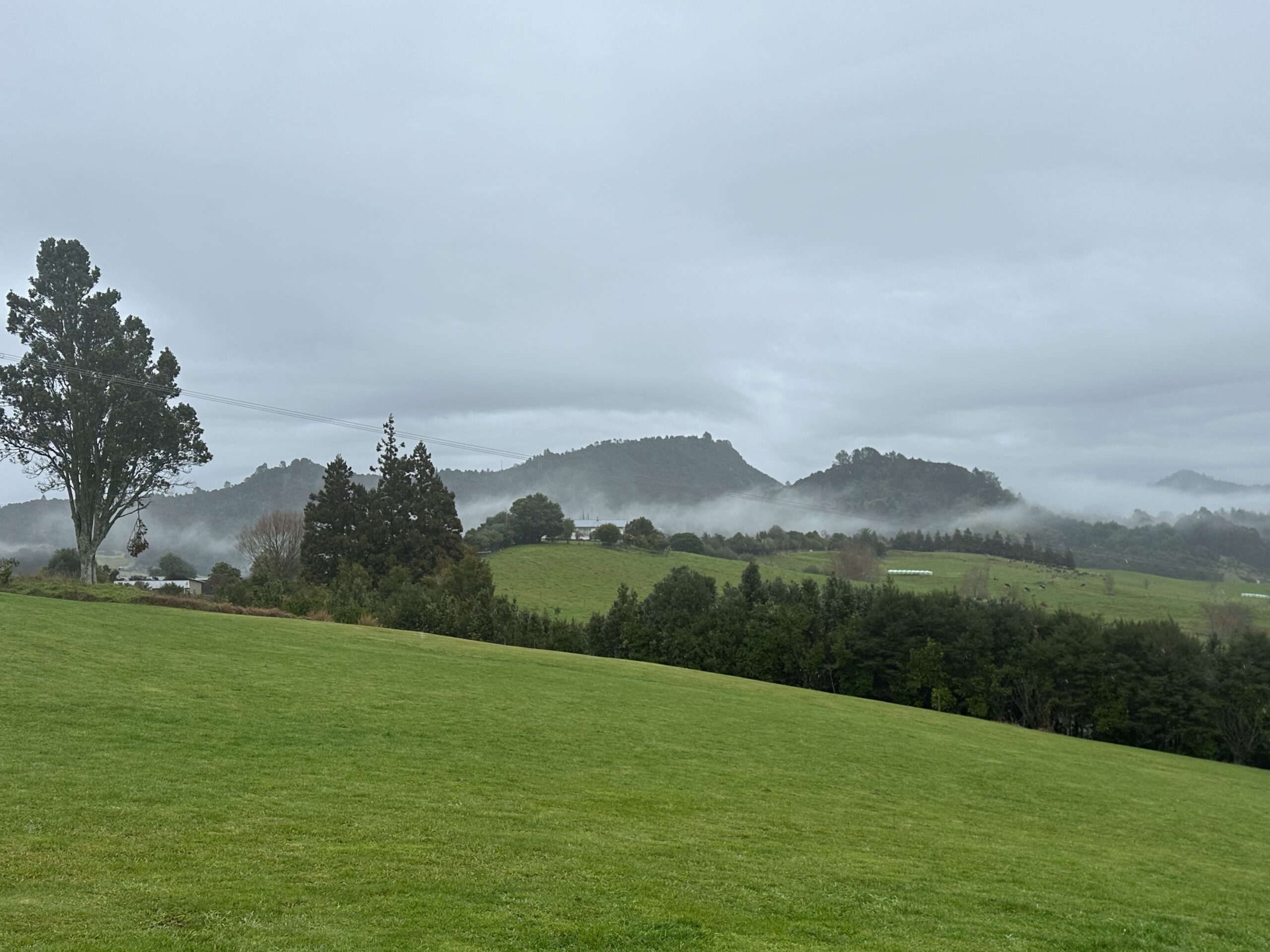
And I’m sorry that this post is SO LONG. I have sprinkled in beautiful photos of New Zealand to hold your interest.
When I was visiting my family and friends in the States last October, I had a number of people ask me to report back on what it was like to have Christmas in summer. I am reporting back to tell you that, much like my December “birthday,” Christmas felt like “Christmas,” in quotes. Don’t get me wrong; it was an absolutely lovely day. It just didn’t feel like Christmas as I know it.
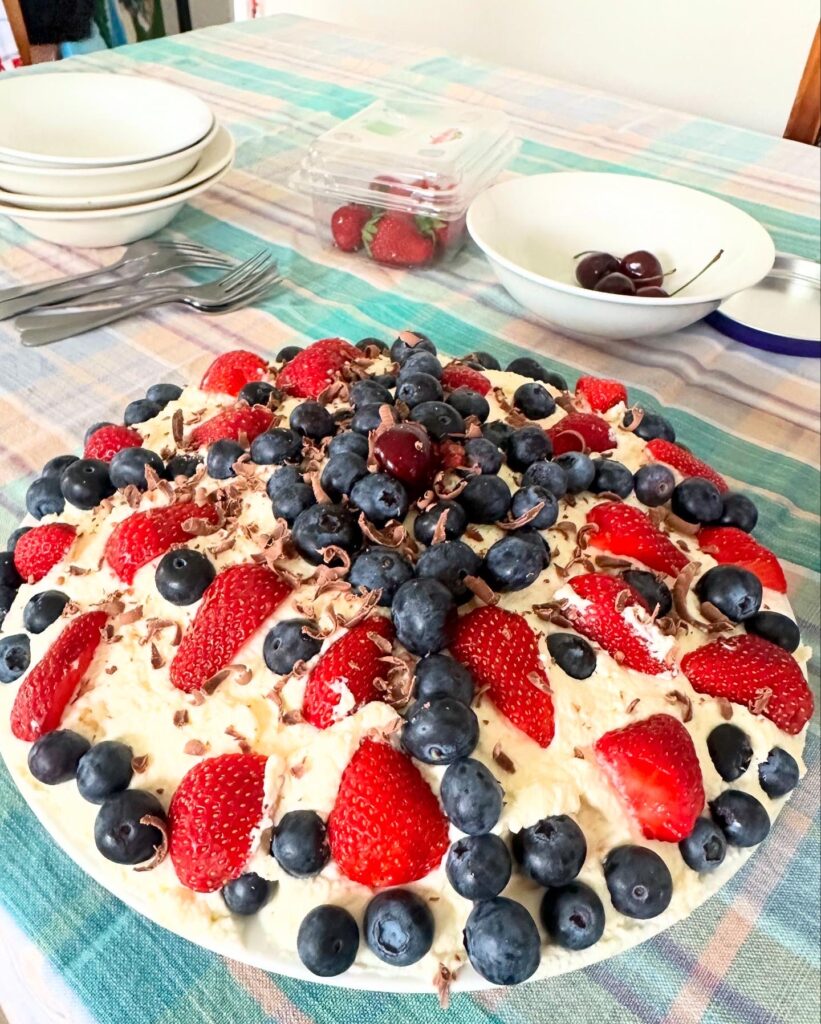
I spent the day at a friend’s house with Stu and the boys. Temperatures were in the mid 70s and sunny, and the backyard was filled with vibrant blooms of flowers. We barbecued in the back yard (as one does in New Zealand on December 25th) and played with the boys’ new presents. And then I had the utmost honor/honour of decorating the pavlova, which is a traditional meringue-based dessert that originated in New Zealand NOT IN AUSTRALIA. This is a hotly, hotly contested subject, and since I am applying for residency in New Zealand, I feel it necessary to emphasize that the pavlova is, without a doubt, obviously, a dessert of Kiwi origin. Wherever it originated, pavlova, particularly when homemade and slightly gooey on the inside and slightly crusty on the outside, is delicious.
Ta da: my first pavlova! Baked by Stu, decorated by me and the boys.
But man oh man, does it feel bizarre listening to Christmas carols and unwrapping gifts in summer. At one point, while helping to tidy up the wrapping and tissue paper, I reflexively turned to throw them into the fireplace. Muscle memory, I suppose.
And even though we didn’t end up making it to midnight, it was also a trip celebrating New Year’s Eve doing something other than standing around a bonfire in the snow wearing a winter jacket, boots, scarf, mittens, and a hat, feeling 50% festive and 50% miserable, drinking beer just to stay warm. By the way, New Zealand is one of the first countries in the world to enter the New Year. The first country is the tiny island nation of Kiribati, but they only beat NZ by an hour. (Hawaii is one of the last places in the world to see the New Year).
On to the visa update...
Five days ago, I submitted my application for the second of three visas. I should hear back in about 7 months [nervous exhale].
Since it’s been a while, let me reiterate my visa situation as it stands:
I am currently here on a one-year Partner of a New Zealander Work Visa, which expires May 21, 2025. The next one, which I just applied for, is the Partner of a New Zealander Resident Visa. Before you freak out with excitement, this is not “THE” visa that grants me permanent residency, which is the end goal. What this visa does is allow me to continue to live and work in NZ, and travel to and from NZ, for two years. Basically, it extends my current situation by 24 months. (Something puzzling that I recently worked out: Immigration has the length of stay for this visa as “Indefinite,” but it also says “Your travel conditions will expire 2 years from the date you first arrive in New Zealand as a resident.” Confused by this seeming contradiction, I did a deep dive and found out that apparently, you can live and work in NZ for the rest of your life just on a Resident Visa–so long as you never leave NZ after your “travel conditions” expire).
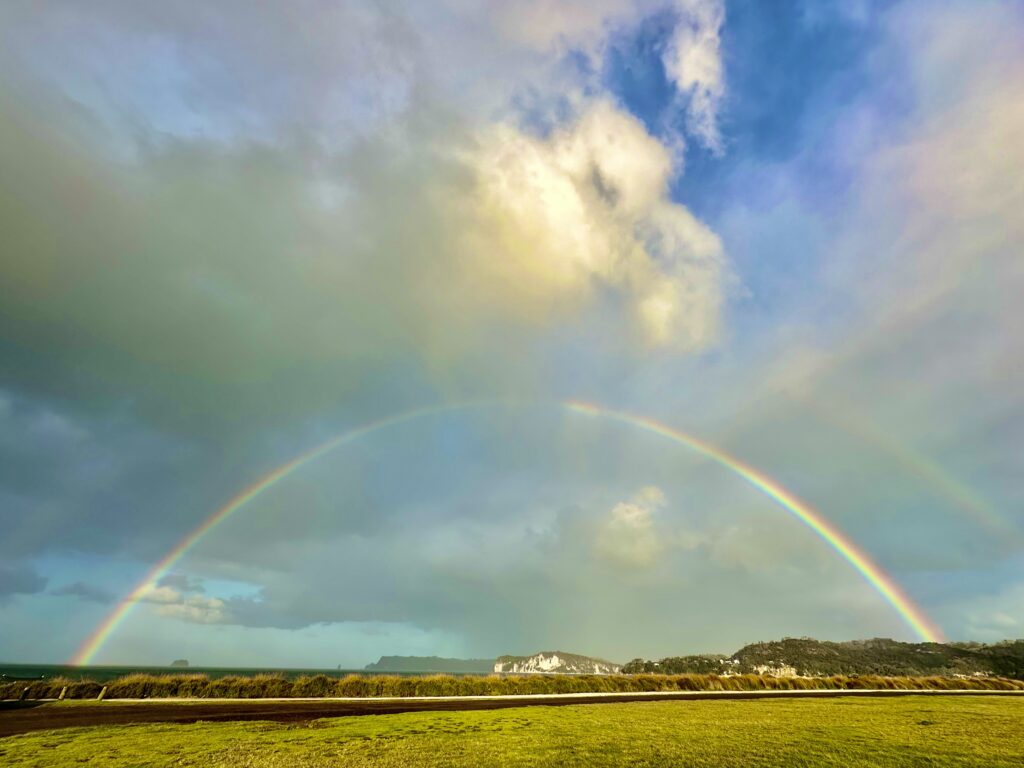
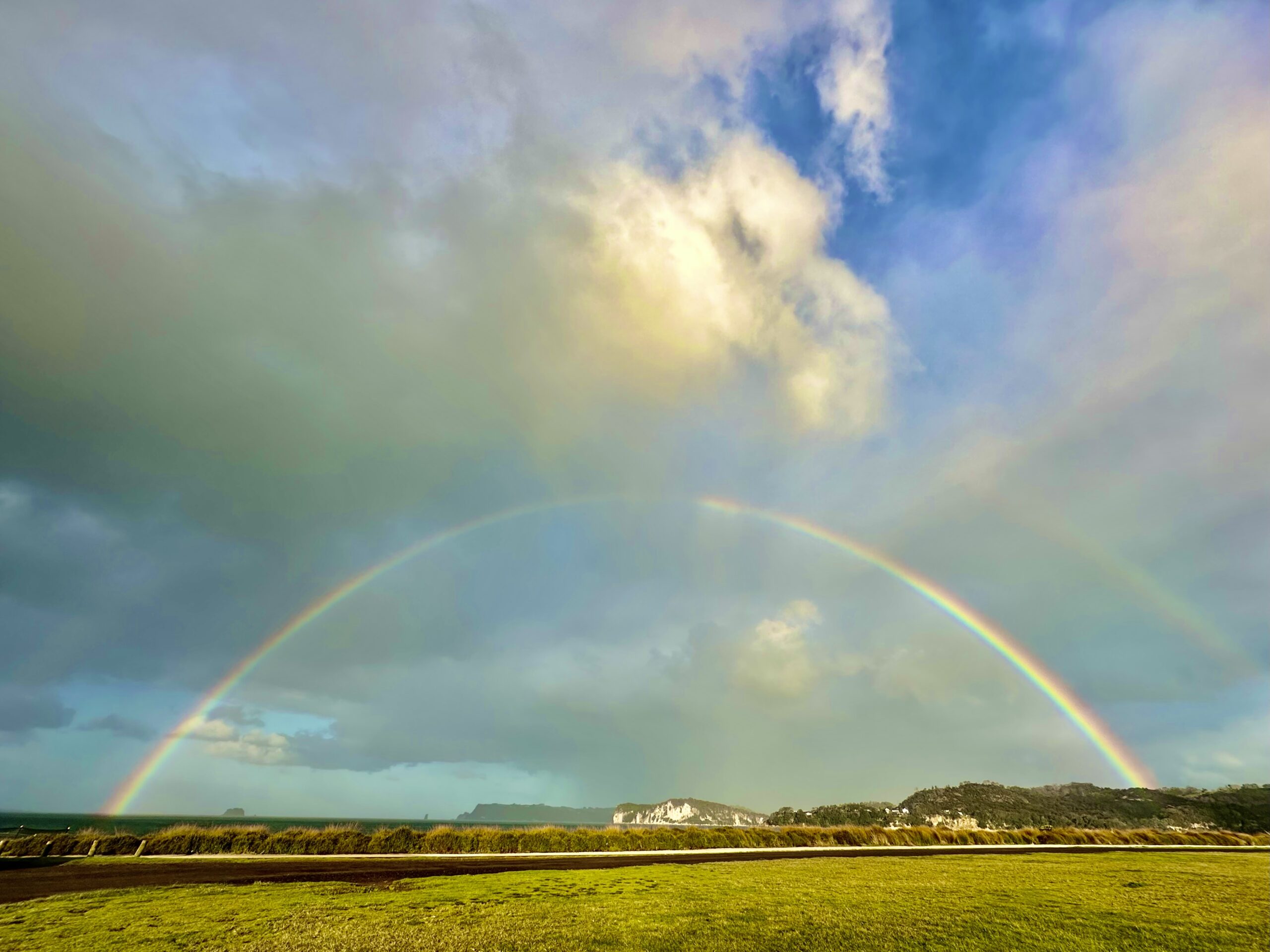
Please enjoy this picture of a full rainbow over Mercury Bay that I took back in September:
After two years of being on the Partner of a New Zealander Resident Visa, I apply for a Permanent Resident Visa. That is the biggie: the one that will allow me to live in New Zealand, and travel in and out of New Zealand, forever. 🍾 🥂 🎉 🌟
After five years of being a Permanent Resident, I can choose to, but am not required to, apply for New Zealand citizenship. For those of you wondering what the differences are between a Permanent Resident and a Citizen, I have put all of that information at the very end of this post. To answer a common question: yes, being a Permanent Resident gives me the right to vote. To answer a question no one has asked me because who would think to ask this: I recently found out that if I become a NZ citizen, the oath of citiizenship I have to recite begins like this: “I, Hilary Emerson Lay, swear that I will be faithful and bear true allegiance to His Majesty King Charles the Third, King of New Zealand…”. Then, according to Wikipedia, “new citizens then join in the singing of God Defend New Zealand before enjoying a cup of tea.” Americans are allowed to have multiple other citizenships, but I’m legitimately worried that my U.S. citizenship will automatically be revoked upon my swearing allegiance to the Crown?!
So that’s my visa timeline. One visa under my belt, one visa application in the works, one visa left to go after that. If all goes as planned, I should have Permanent Residency around September 2027. 🤞🏼🤞🏼🤞🏼
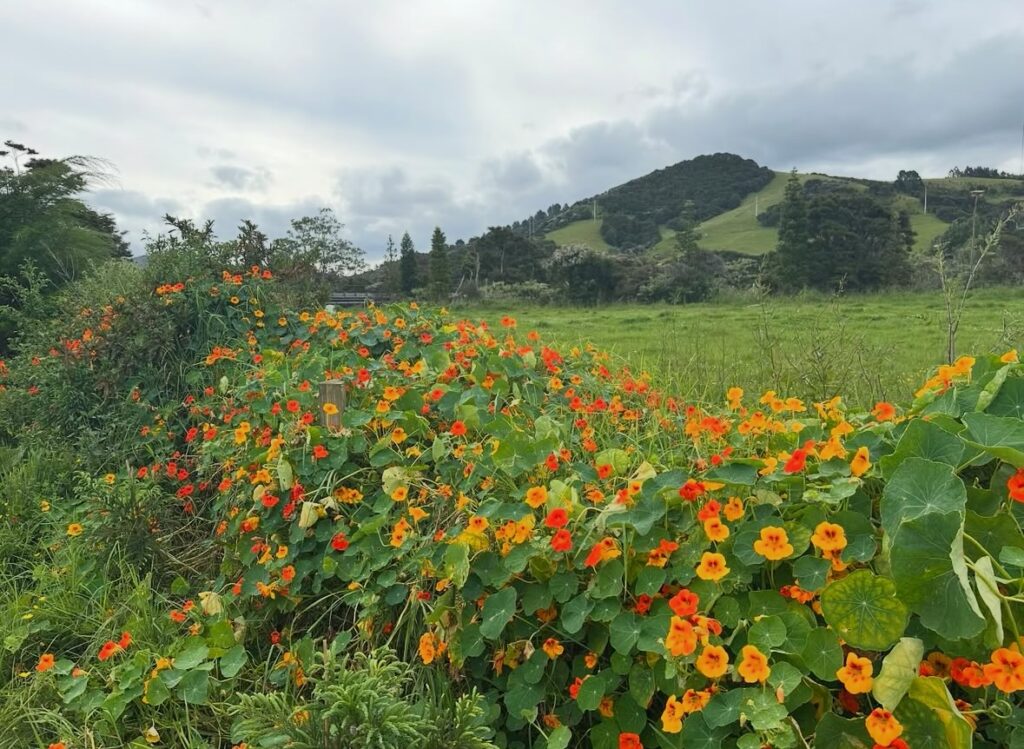
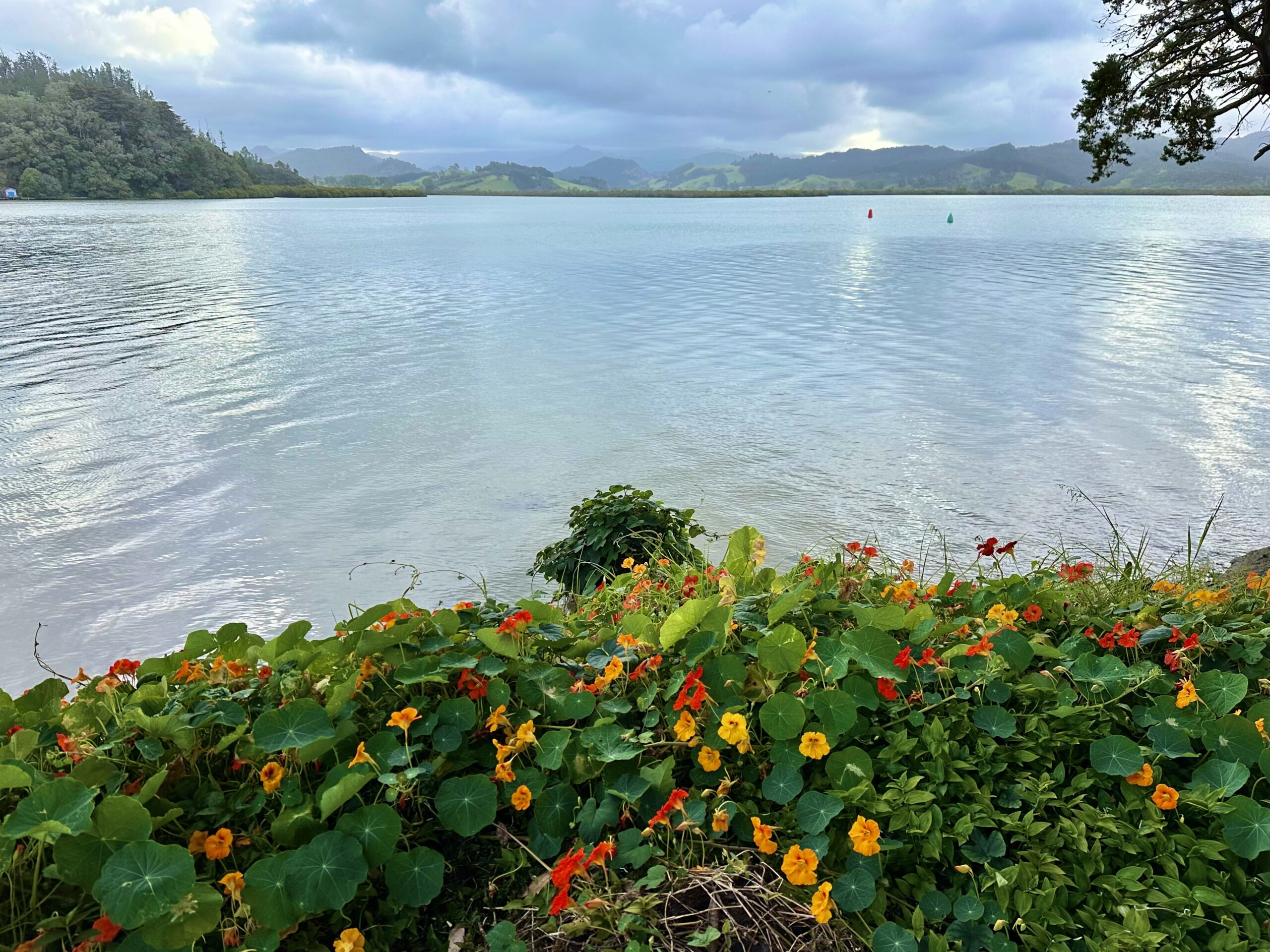
Here is a pretty picture of nasturtiums growing along a fence in Kaimarama:
It wasn’t until mid-November, when a fellow American I met at a concert here in NZ reached out to commiserate with me about the outrageous visa price hike, that I found out about the outrageous visa price hike. On October 1 of last year, Immigration New Zealand quietly doubled the cost of all visas.
I say “quietly” because I never read a thing about it. After googling it I found this announcement back in early August saying that Immigration New Zealand would be “significantly” raising its costs as of October 1. It was not a widely covered news story, but it damn well should have been. I find it a horrific oversight that those of us here on any type of visa wouldn’t have gotten a heads-up email from Immigration about the doubling of fees. There’s not much any of us could have done about it, but it would have been nice to at least know.
Here’s how crazy the new prices are: the Partner of a New Zealander Work Visa–the visa I am currently here on–cost me $860 NZD when I applied in March. It now costs $1,630.
(Here is a pretty picture of the view from a customer’s back yard in Matarangi to soften the upcoming blow:)
The one I just applied for, The Partner of a NZer Resident Visa, which has always been the most expensive of the three, went from $2,750 NZD ($1,530 USD) to………….
$5,360 NZD. $3,024 USD. 😱
This sudden, massive increase in visa fees is apparently the doing of the National Party, who claim that more money is needed to process the large number of visas they get every year. Opponents say the move will discourage people from moving here, which they claim is National’s intended goal.
Immigration Minister Erica Stanford stated that “these changes aim to shift the cost of the country’s immigration system from taxpayers to those benefiting from it,” and that “the new charges reflect the costs associated with visa processing, assessing, and managing more high-risk applications, and increased compliance costs as we deal with higher levels of migrant exploitation, managing more asylum claims, and maintaining and upgrading Immigration New Zealand’s ICT systems.”
I’m all for reducing migrant exploitation and helping people seeking asylum, and I don’t know or care what an ICT system is. But the “high risk” thing really pisses me off. Because a quick internet search told me that a “high risk” risk visa application would be one where “the applicant is considered likely to pose a potential security risk to the country due to factors such as criminal history or concerns about their character, which leads to a more thorough vetting process by Immigration.” Why should I have to pay more for my not-security-risk-to-the-country visa application so that Immigration can better process a visa application from someone who is “likely” to pose a potential security risk to the country? Shouldn’t they just charge them more??
But some good news did follow the bad news: the processing time for the visa I just applied for went from 9-12 months down to 7 months. The original idea of having to be away from my loved ones back home for 12 months was killing me. So in all honestly, I’d rather have to pay this surprise extra $1,500 and spend less time away from everyone I love back home. The power of positive thinking, right? Also, the exchange rate right now is the best I’ve ever seen ($1 USD to $1.79 NZD), so I put the application fee on my credit card that I pay off in USD—and I get a bunch of airline miles that I’ll use for my next trip home in only 7 (not 12!) months. Win/win.
All of this visa Googling gave me a thought: could I apply for my Resident Visa earlier than May 21, 2025? Did I have to wait until right before my current visa expires to submit my next application? I called Immigration and spoke with a lovely woman named Linda who proceeded to take me on a rollercoaster ride of emotions.
She said that no, I did not have to wait until May to apply for my next visa. The requirement for the Partner of a NZer Resident Visa is that you and your partner have been living together for 12 months. As soon as Stu and I hit the 12 month mark on January 4, I could submit the next visa.
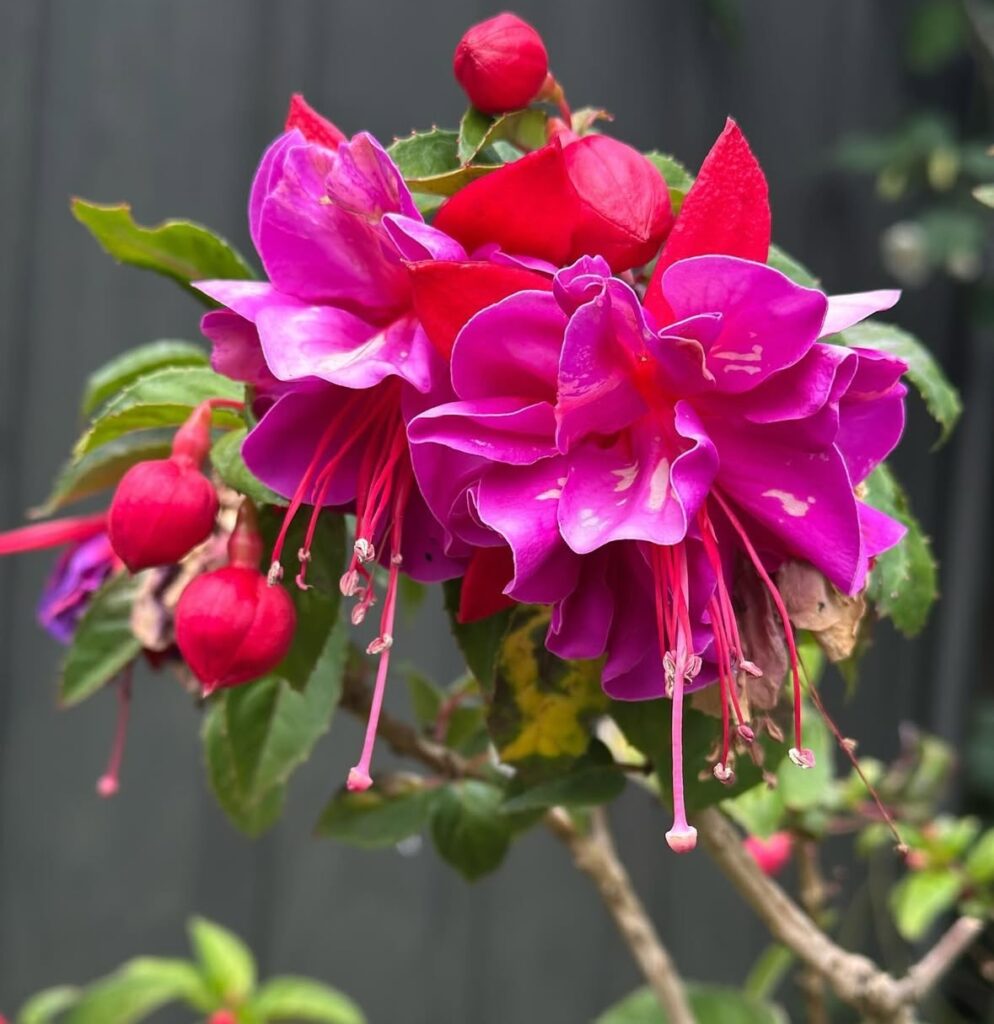
We interrupt this programme to bring you a pretty picture of a fuchsia from our garden:
But then Linda reminded me about something I knew at one point but must have conveniently blocked out: they do not grant Interim Visas for people applying for Resident Visas. When I was here on my 90-day Visitor Visa back in March and submitted my Work Visa, they automatically granted me an Interim Visa that allowed me to stay in NZ (without working, obviously) until they made a decision on my Work Visa. But they do not do Interims for Resident Visas. And I can’t, obviously, be in the country without a valid visa. And since my Work Visa expires May 21, 2025 and my Resident Visa will likely not be approved until July or August 2025, I have one of two unpleasant options:
1: Reapply and re-pay-for the !!@!@#$% Partner Work Visa I’m already on (to the new tune of $1,630 NZD) just to cover me for an approximate two month gap in visas.
2: Leave the country before May 21 and then come back when my Resident Visa is approved. But that would mean leaving NZ for more than two months, and the $1,630 NZD to renew my Work Visa is cheaper than it would be for me to fly home (or anywhere else) and miss work for two months.
“Maybe,” I said to Linda at Immigration in a hopeful little voice, “my Resident Visa will be approved before my Work Visa expires, so I don’t have to pay for it all over again just for, like, 8 weeks of coverage?”. Linda hesitated. “It’s very unlikely…..but yes. Maybe.” I’m going to cling to Linda’s “maybe.”
Linda did give me a bit more good news, though: my “police certificate” (aka the FBI background check from Dec 2023) and my expensive medical exams done here in NZ in Jan/Feb 2024 are all still valid for the next visa, meaning I didn’t need to go through and pay for any of that again. Thank god.
Being the neurotic person that I am, I started my visa application back in June, since you can save your progress as you go and I wanted to see what this application entailed and whether or not I’d need to collect even more evidence ahead of time. It’s essentially the exact same application as the one I did last year except they want a little more information for this one. My next post, likely a boring one for most of you, is a step by step breakdown of everything they ask for in the application.
It’s a huge relief that the final visa I need to obtain–the Permanent Resident one–only costs $315 NZD and has a two week approval turnaround time. I’d rather get the shitty expensive one with the longest wait time over with sooner, rather than have it looming down the pipeline.
Pictures from an overnight in Hahei a few weeks ago:
And that’s al the news from here. New Year, hopefully new visa. Now I wait.
Much love to all of you. I’m glad you’re along for this wild ride with me. H. ❤️
As promised: for anyone who is interested, this is the difference between a Permanent NZ Resident and a NZ Citizen, as taken from the Pathways NZ website (Pathways is a collective of licensed immigration officers):
New Zealand residence entitles the holder the right to live, study and work in New Zealand and to: • be eligible for publicly funded health and disability services • have access to education in state education institutions the same as local students and tertiary fee subsidies and student loans (after a qualifying period) • be eligible for social welfare benefits • vote in local and general elections • service on a jury • to buy a home and property once settled • have a career in the New Zealand defence forces
In order to be eligible for the grant of New Zealand citizenship a person normally must: • have held a New Zealand resident visa and lived in New Zealand for a total of at least 1,350 days during the five years immediately before making their citizenship application; and • have lived in New Zealand for a total of at least 240 days in each year of the five years immediately preceding the date of their application
Citizenship applications are processed by the Citizenship Office which is part of the Department of Internal Affairs, and each person must meet the eligibility and make a separate application.
In addition to all of the above rights conferred by New Zealand residence New Zealand citizenship provides full economic and social rights including: • holding a New Zealand passport and being able to travel internationally on this passport • access to New Zealand Embassy/Consular support and assistance when overseas • standing for New Zealand Parliament and local government roles • representing New Zealand in international sports (e.g., Olympics) • being eligible for education scholarships which are only open to New Zealand citizens • being able to visit, live and work in Australia (by being issued a Special Category Visa automatically on arrival as a New Zealand citizen)
Let me start by apologizing for not having posted since August. So much for my intention of starting a blog where I’d be “posting regularly” and “keeping my readers engaged”. My only partial excuse for my lapse in posts is that I have a lot less time to write now that I work full-time, but I could *absolutely* be watching fewer Netflix true crime documentaries and making better use of the free time that I do have. I actually have been writing; I have more than two dozen draft posts going at any given time. I just haven’t managed to finish anything since…well, since August, apparently.
Anyway, I have an unexpected day off due to torrential downpours, so I’m finally ripping off the bandaid (“plaster”) and finishing this one.
Moving on to the aforementioned “SO much to fill you in on.”
Last Wednesday was, according to the calendar and the humbling number of messages I received from both sides of the pond, “my birthday.” But it didn’t feel like my birthday. At all. Because in New Zealand, being born on December 4th means you have a summer birthday.
For the majority entirety of my life until this point, I’ve had a winter birthday, which, where I’m from, means 1. zero leaves on the trees 2. permanently overcast grey skies 3. occasional snow 4. utter darkness and despair when the anemic “sunlight” disappears at 4:30 pm 5. temperatures cold enough that you can see your breath outside and 6. all the mini golf courses where as a kid you desperately wanted to have your birthday party are shuttered for the season and all of those alluring, giant, colorful animal and pirate figurines are wrapped up tightly against the damage of a harsh New England winter. So having everyone wish me a Happy Birthday on a 74 degree, humid, sunny day where everyone was out and about enjoying the beautiful weather and the mini golf course was open felt like all of my friends and family had collectively decided to prank me with birthday messages. It was, no exaggeration, surreal. And Stu, who’s birthday is in July–a winter birthday here in New Zealand–would have a summer birthday in the States. It’s like having upside-down birthdays. 🙃 🎂
pōhutukawa
Sunday, December 1st was the first official day of summer here in New Zealand. Their seasons begin on the first day of every third month: December 1 marks the start of summer, March 1 is fall, June 1 is winter, and September 1 is spring; so easy to remember! It definitely feels like summer, but it doesn’t even remotely feel like December. The weather here right now is in the high 60s to low 70s, mostly full sun, occasionally muggy and humid. The intense sunlight, blossoming pōhutukawa trees (aka the New Zealand Christmas Tree, pictured here), summer attire everywhere, ads on the radio announcing summer events, and stores prominently displaying summer merchandise next to Christmas merchandise while “Santa Baby” plays throughout the building is confusing the hell out of me. IT’S SO WEIRD YOU GUYS.
But a lot more than upside-down birthdays and intense seasonal confusion has happened since August. In no particular order:
1. I got a new car–an equal parts really reliable and really funky-looking old Totoya Echo (an Echo is sort of like a Yaris squished into a cube shape). I found out in September that my dear old Alfa needed a new engine. I don’t know a lot about cars, but I was correct in assuming that I could get an *entire other car* for less than it would cost me to replace an entire Alfa Romeo engine. 2. I booked the Whitianga Town Hall for 9 days in January to run a mini half-day art camp (yay!). My dream is to eventually run a summer-long kids art “holiday programme” here in Whiti, so this is sort of my soft opening attempt at testing the waters. 3. I’ve changed my hair color about six times. 4. New Zealand Immigration significantly raised the prices of visas on October 1st. Significantly raised them. I’ll post about that. 5. A friend from Cape Cod (well; technically the daughter of an old friend, but she’s definitely a friend now!) just moved to my little NZ town for three months. She was planning to live somewhere on the North Island for the summer, and I may or many not have lured her to Whitianga. It’s been wild having a friend from the Cape suddenly living down the road from me!
Oh yeah, and I took Stewart to the United States to meet everyone!
Here’s a photo of me, Stu, and my parents at their house on Cape Cod in October. He finally, after 4.5 years, got to meet my beloved awesome family and some of my closest friends, and they, after 4.5 years, finally got to meet him. It was so. much. fun.
We flew over together in late September; he stayed for two weeks (we booked the trip to align with his spring vacation from the school where he is the school librarian) and I stayed until early November. To answer a frequently asked question: yes, Stu hasbeen to the States a couple of times, but not since 2012, and he never went anywhere near my neck of the woods (which is New England/the northeast/the upper right-hand corner of the USA).
We saw so many people and did so many things in those two weeks. We got to spend good chunks of time with my parents and my sister and her partner. I introduced him to some of my best Cape Cod friends, some of my closest North Shore friends, some of my nearest and dearest Western Massachusetts friends, and one of my awesome cousins. Some of them had “met” Stu on video chat a few times over the years, but of course it’s not the same as everyone meeting in person. There was an abundance of big, warm, welcoming hugs from everyone.
For the Cape tour, we stopped in at Instant Karma Records in Orleans (for Stu it was pure love at first sight), drove up to Wellfleet and got Box Lunch which we sat and enjoyed at Wellfleet Harbor–one of my favorite spots on the Cape–and made it up to Provincetown with just enough time to briefly explore Commercial Street and enjoy drinks on a deck overlooking the water before I had to whiz us back for an incredible night with my parents and our longtime family friends Paula and Chris, the latter of whom is a musician. Chris and Stu have had a long-distance musical love affair for a while via social media, and when they finally got to jam together on their guitars it was magic. My Dad put it best when he said that it was like listening to a musical conversation flowing seamlessly back and forth. I think we stayed for four hours that night, and then went back a few days later for another round of duets. Chris let Stu borrow a guitar for the duration of our trip, a guitar which actually belonged to my Dad back when he was a Boston University undergrad. Chris had it restored a few years ago as a surprise. It was touching to have Stu give a new life to my Dad’s old college guitar. Other Cape Cod adventures included a trip to the Edward Gorey House and then stopping at a roadside farm stand where Stu got to wander through hay bales and pumpkins galore. He tried apple cider and some raw cranberries (Cape Cod is famous for its cranberries. Raw cranberries, in contrast to sweetened cranberry juice, are almost painfully tart, something Stu realized almost immediately, though to his credit he didn’t spit them out).
The beautiful Boston Gardens with a statue of George Washington behind us. Yes, I had to google who the dude on the horse was.
We explored downtown Boston and a bit of Cambridge for an afternoon, where I took him to the Boston Commons and Gardens, the Boston Public Library, The Harvard Bookstore, and an off-the-beaten-path vinyl shop.
I introduced him to the glories of Halloween by taking him to Salem, Massachusetts in the middle of October, when “Witch City” is at the height of Halloween frenzy (Halloween is a fairly recent addition to New Zealand and, compared to what we’re used to in the States, is very small-scale). He played an open mic at Gulu-Gulu Café with my friend Jenne, which was something I’ll never forget. He tried candy corn for the first time, and when we got back to the Cape he got to carve jack-o-lanterns with my family (his was fantastic! Photo below).
I couldn’t wait to take him out to Western Mass and show him the overwhelming beauty of a real New England autumn. Due to a particularly dry summer, the foliage wasn’t *as* stunning as it can be, but for the uninitiated, it was spectacular. We had dinner with friends, explored downtown Northampton, and hiked to the top of Mt. Sugarloaf for an extraordinary view of the Pioneer Valley and Connecticut River. And he played another open mic, this one at Luthier’s Co-Op, a legendary spot.
We packed so many adventures and experiences into just ten days. I took him to a real American diner where he got steak and eggs for breakfast. I introduced him to the glory of sour beers, which unfortunately don’t seem to widely exist here in KiwiLand. I took him to my beloved Trader Joe’s grocery store. We went to Fall Festival at a city park just north of Boston and he got to hold his first snake (no, they don’t have snakes in NZ, and no, I don’t know why they have a snake guy at a fall festival). I am not including a photo of Stu and the snake because I know my Mom will be reading this and she strongly dislikes snakes (you’re welcome, Mom) but I’m happy to send it to anyone who isn’t my Mom and wants to see it.
And then he flew back for the start of the last school term and I stayed an additional 3.5 weeks to spend more time with everyone. And now I’m back in New Zealand and it’s somehow summer but also December.
We had such an incredible trip. Thank you so much to all of you who helped make Stu’s time in the States unforgettable. We can’t wait to see you all again!
And to everyone else, thanks for reading. It feels good to be writing for you again. I’ve missed you guys!
Love, Hilary ❤️
PS: As always, you can follow my New Zealand Chronicles Instagram account here, where I regularly post beautiful photos (like these ones), which will hopefully help all of you back home get through the winter.